First pedal build and it doesn't work

Chase42147

Chase42147

Active member
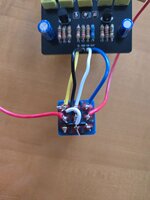
So I bought a PedalPCB Uberdrive (SD-1 style overdrive) about a year ago, and it didn't work the first time around. I got a nasty sound when I plugged it in, and shelved it for a year. Yesterday I pulled it out of the box to give it another go. I realized I missed one jumper cable on the on/off switch... And then I noticed I had soldered the tip contacts on the input and output jacks to ground. Reversed the wires on the jacks and now I at least get signal through the pedal. I have two problems now.
1) The gain pot doesn't do anything at all.
2) I get a noticeable volume drop when I engage the pedal. I don't have the on/off indicator LED installed, I'm guessing that doesn't affect anything. I'd install it but I have to clear solder out of the holes first. Also, I used 2SC1815 transistors instead of 2SC732's, as I couldn't find the latter. According to my research that's an acceptable substitution, but I could be wrong. If anyone could point me in the right direction that would be awesome
 

Attachments

  • 20260314_132558.jpg
    20260314_132558.jpg
    1.6 MB · Views: 26
  • 20260314_132616.jpg
    20260314_132616.jpg
    1.4 MB · Views: 21
  • 20260314_132604.jpg
    20260314_132604.jpg
    1.2 MB · Views: 21
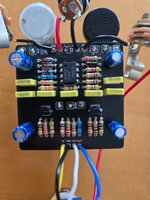
It’s hard to tell from the pictures but it looks like there could be several dry solder joints and maybe some bridged solder joints (see where transistor is soldered) from the picture of the back of the pcb.

I would first go though and touch all of those up. Pedalpcb’s pcbs are nice quality but compact with small solder pads.
 
So I bought a PedalPCB Uberdrive (SD-1 style overdrive) about a year ago, and it didn't work the first time around. I got a nasty sound when I plugged it in, and shelved it for a year. Yesterday I pulled it out of the box to give it another go. I realized I missed one jumper cable on the on/off switch... And then I noticed I had soldered the tip contacts on the input and output jacks to ground. Reversed the wires on the jacks and now I at least get signal through the pedal. I have two problems now.
1) The gain pot doesn't do anything at all.
2) I get a noticeable volume drop when I engage the pedal. I don't have the on/off indicator LED installed, I'm guessing that doesn't affect anything. I'd install it but I have to clear solder out of the holes first. Also, I used 2SC1815 transistors instead of 2SC732's, as I couldn't find the latter. According to my research that's an acceptable substitution, but I could be wrong. If anyone could point me in the right direction that would be awesome
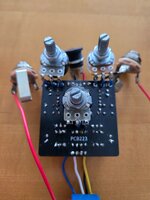
first off you should get some of these ... they will work a 1000 times better for the build depending on where you buy them you'll need to get dust covers for them so they don't ground out against the PCB ....

I would reflow the whole board ...... I noticed on the second pic that shows the solder joints .... the bottom right electrolytic isn't soldered properly ...

you can see the open pad under the small solder blob ... so I bet a week's pay that leg is floating killing the whole circuit

A tip when soldering these PCB's ..... anything that has a NET to Ground .... is going to take a little longer to heat up and receive the solder .... due to it being attached to the Ground plane that runs the whole board ... there's simply more mass ...

and usually 90% of the time electrolytics have a Ground NET .... and are a little tougher to solder correctly

other than that like mentioned above you have some spots that look to be connecting with solder ...bridging them .... when you reflow just make sure no solder spots are touching
1773590289871.png
 
It’s hard to tell from the pictures but it looks like there could be several dry solder joints and maybe some bridged solder joints (see where transistor is soldered) from the picture of the back of the pcb.

I would first go though and touch all of those up. Pedalpcb’s pcbs are nice quality but compact with small solder pads.
Yeah I realized after uploading the pics that the camera focused on the pot, rather than the pcb in the one pic lol. I looked at the spot you mentioned, there's not actually a bridged joint at the transistors, it's just the camera angle. But yeah, I'll go through and touch up the solder points.

What are some good brands with bigger solder pads? I'd like to get good enough to build these ones well, but I was struggling big time with how small the pads are.
 
first off you should get some of these ... they will work a 1000 times better for the build depending on where you buy them you'll need to get dust covers for them so they don't ground out against the PCB ....

I would reflow the whole board ...... I noticed on the second pic that shows the solder joints .... the bottom right electrolytic isn't soldered properly ...

you can see the open pad under the small solder blob ... so I bet a week's pay that leg is floating killing the whole circuit

A tip when soldering these PCB's ..... anything that has a NET to Ground .... is going to take a little longer to heat up and receive the solder .... due to it being attached to the Ground plane that runs the whole board ... there's simply more mass ...

and usually 90% of the time electrolytics have a Ground NET .... and are a little tougher to solder correctly

other than that like mentioned above you have some spots that look to be connecting with solder ...bridging them .... when you reflow just make sure no solder spots are touching
Yeah I really should have used those pots instead. I was just impatient and the store I was getting parts didn't have any in the right values. Maybe I should redo it with those.

By reflow the solder, do you just mean reheat, or reheat and add more solder?

Oh man, I didn't notice that! I'll get on that one first.

What do you mean by NET? And how sensitive are the components themselves to heat usually? Like if you have to apply more heat to the electrolytics. is there no worry about overheating the capacitor itself?
 
sorry ..... NET basically means connection ...

yup .... re flow means exactly that ... sometimes just retouching the spot till the solder remelts is enough .... doesn't hurt to add a touch more either though ... as long as you're not blobbing ..

you've got a couple seconds ..... just give it a minute or two to cool .... if your trying multiple times
 
sorry ..... NET basically means connection ...

yup .... re flow means exactly that ... sometimes just retouching the spot till the solder remelts is enough .... doesn't hurt to add a touch more either though ... as long as you're not blobbing ..

you've got a couple seconds ..... just give it a minute or two to cool .... if your trying multiple times
Oh ok, gotcha.

Alright, I'll give that a go. I'll have to be careful to not add too much, there's quite the buildup on the backside already.

That's good to know, thanks! Guess I didn't have to rush quite that much then.
 
You should post this on the PedalPCB forums.. they'll have you fixed up real quick.
 
Yeah I realized after uploading the pics that the camera focused on the pot, rather than the pcb in the one pic lol. I looked at the spot you mentioned, there's not actually a bridged joint at the transistors, it's just the camera angle. But yeah, I'll go through and touch up the solder points.

What are some good brands with bigger solder pads? I'd like to get good enough to build these ones well, but I was struggling big time with how small the pads are.
To be honest pedalpcb has such a large catalogue of circuits, not riddled with errors like some others, as well as great support and a busy forum, it’s worth practicing on their PCB’s and getting proficient. A sharp solder tip and temperature controlled iron are well worth getting if you plan to keep building pedals.
 
You should post this on the PedalPCB forums.. they'll have you fixed up real quick.
I posted there too, I did get a few responses. One also mentioning the cold solder joints, and one guy PM'd me and recommended that I build a Mad Bean proto rig. I think I'll look into that unit. I'm not totally sure how it tests pedals, but it seems interesting
 
To be honest pedalpcb has such a large catalogue of circuits, not riddled with errors like some others, as well as great support and a busy forum, it’s worth practicing on their PCB’s and getting proficient. A sharp solder tip and temperature controlled iron are well worth getting if you plan to keep building pedals.
Ok, that makes sense. I'll just stick with them then. I do have a sharp soldering tip, but it seemed like I had to hold it there forever to transfer enough heat, and switched back to a rounded one. My iron is temp controlled though. What temperature would you recommend for soldering pedals?
 
The pedal works!! Hell yeah!! I did like you guys said, and reflowed the solder on several components. Particularly two of the electrolytic caps, a few of the other caps, the diodes, the transistors, a few resistors, a couple legs on the opamp, and then the gain pot. Boom, sounds like a totally different pedal, or, rather, actually sounds like a pedal at all now. I'm just happy I didn't overheat the opamp, that would have been miserable to desolder. Thanks for the input everyone!
 
Ok, that makes sense. I'll just stick with them then. I do have a sharp soldering tip, but it seemed like I had to hold it there forever to transfer enough heat, and switched back to a rounded one. My iron is temp controlled though. What temperature would you recommend for soldering pedals?
I usually have mine at about 350c (660f), some people use higher.

Good quality solder also helps, and helps to wet the solder iron tip with solder, a dry tip will have trouble transferring heat into the part and the pad. Try to touch both pad and component leg at the same time, both must come up to temperature for solder to wick to them.

The best thing to do is practice, as you’ll find what techniques work best for you.

Also I would recommend getting sockets for op amps, makes soldering them way less stressful and much easier to swap in the future.
 
I usually have mine at about 350c (660f), some people use higher.

Good quality solder also helps, and helps to wet the solder iron tip with solder, a dry tip will have trouble transferring heat into the part and the pad. Try to touch both pad and component leg at the same time, both must come up to temperature for solder to wick to them.

The best thing to do is practice, as you’ll find what techniques work best for you.

Also I would recommend getting sockets for op amps, makes soldering them way less stressful and much easier to swap in the future.
Thanks for all the tips, I'll keep them in mind on my next build. Good call on the IC sockets too. I'll make sure to buy a few of those!
 
Back
Top