Christos Anesti

  • Thread starter Thread starter VonBonfire
  • Start date Start date
V

VonBonfire

Well-known member

Today's Saint is:
1776100673969.png

"The Priest-Martyr Ipatios, Bishop of Gangra, was bishop of the city of Gangra in Paphlagonia (Asia Minor). In the year 325 he participated in the I O Ecumenical Council at Nicea, at which the heresy of Arius was given anathema.

When Saint Ipatios was returning in 326 from Constantinople to Gangra, followers of the schismatics Novatus and Felicissimus fell upon him in a desolate place. The heretics ran him through with swords and spears, and threw him from an high bank into a swamp. Like the First-martyr Arch-deacon Stephen, Saint Ipatios prayed for his murderers. A certain Arian woman struck the saint on the head with a stone, and he died. The murderers hid his body in a cave, where a christian who kept straw there found his body. Recognising the body of the bishop, he hastened to report about this in the city, and the inhabitants of Gangra piously buried the remains of their beloved arch-pastor.

After death the relics of Saint Ipatios won reknown for numerous miracles, in particular the casting out of demons and for healing the sick. From of old the Priestmartyr Ipatios was particularly venerated in the Russian land. Thus in the year 1330 was built at Kostroma the Ipatiev monastery, on the place of an appearance of the Mother of God with the Pre-eternal Christ-Child and saints that were present – the Apostle Philip and the Priestmartyr Ipatios, bishop of Gangra. This monastery afterwards occupied a significant place in the spiritual and social life of the nation, particularly during the years of the Time of Troubles. The old-time copies of the Vita of the Priestmartyr Ipatios were widely distributed in Russian literature, and one of these entered into the compiling of the Chet'i Minei [Reading Menaion] of Metropolitan Makarii (1542-1564). In this Vita was preserved an account about the appearance of the Saviour to Saint Ipatios on the eve of the martyr's death. The veneration to the saint consists of prayers, words of praise and teaching on the day of his memory. The pious veneration of Sainted Ipatios was also expressed in the liturgical works of Russian authors. During the XIX Century was written a new service to the Priestmartyr Ipatios, distinct from the services written by the Monk Joseph the Studite, contained in the March Menaion."
 
Christos anesti!

1776175890683.png

Newly-Appeared Martyrs of Lesbos, Saints Raphael, Nicholas and Irene were martyred by the Turks on Bright Tuesday (April 9, 1463) ten years after the Fall of Constantinople. For nearly 500 years, they were forgotten by the people of Lesbos, but “the righteous Judge... opened the things that were hid” (2 Macc. 12:41).

For centuries the people of Lesbos would go on Bright Tuesday to the ruins of a monastery near Thermi, a village northwest of the capital, Mytilene. As time passed, however, no one could remember the reason for the annual pilgrimage. There was a vague recollection that once there had been a monastery on that spot, and that the monks had been killed by the Turks.

In 1959, a pious man named Angelos Rallis decided to build a chapel near the ruins of the monastery. On July 3 of that year, workmen discovered the relics of Saint Raphael while clearing the ground. Soon, the saints began appearing to various inhabitants of Lesbos and revealed the details of their lives and martyrdom. These accounts form the basis of Photios Kontoglou’s 1962 book A GREAT SIGN (in Greek).

Saint Raphael was born on the island of Ithaka around 1410, and was raised by pious parents. His baptismal name was George, but he was named Raphael when he became a monk. He was ordained to the holy priesthood, and later attained the offices of Archimandrite and Chancellor.

In 1453, Saint Raphael was living in Macedonia with his fellow monastic, the deacon Nicholas, a native of Thessalonica. In 1454, the Turks invaded Thrace, so the two monks fled to the island of Lesbos. They settled in the Monastery of the Nativity of the Theotokos near Thermi, where Saint Raphael became the igumen.

In the spring of 1463, the Turks raided the monastery and captured the monks. They were tortured from Holy Thursday until Bright Tuesday. Saint Raphael was tied to a tree, and the ferocious Turks sawed through his jaw, killing him. Saint Nicholas was also tortured, and he died while witnessing his Elder’s martyrdom. He appeared to people and indicated the spot where his relics were uncovered on June 13, 1960.

Saint Irene was the twelve-year-old daughter of the village mayor, Basil. She and her family had come to the monastery to warn the monks of the invasion. The cruel Hagarenes cut off one of her arms and threw it down in front of her parents. Then the pure virgin was placed in a large earthen cask and a fire was lit under it, suffocating her within. These torments took place before the eyes of her parents, who were also put to death. Her grave and the earthen cask were found on May 12, 1961 after Saints Raphael, Nicholas and Irene had appeared to people and told them where to look.

Others who also received the crown of martyrdom on that day were Saint Irene’s parents Basil and Maria; Theodore, the village teacher; and Eleni, the fifteen-year-old cousin of Saint Irene.

The saints appeared separately and together, telling people that they wished to be remembered. They asked that their icon be painted, that a church service be composed for them, and they indicated the place where their holy relics could be found. Based on the descriptions of those who had seen the saints, the master iconographer Photios Kontoglou painted their icon. The ever-memorable Father Gerasimos of Little Saint Anne Skete on Mt Athos composed their church service.

Many miracles have taken place on Lesbos, and throughout the world. The saints hasten to help those who invoke them, healing the sick, consoling the sorrowful, granting relief from pain, and bringing many unbelievers and impious individuals back to the Church.

Saint Raphael is tall, middle-aged, and has a beard of moderate length. His hair is black with some grey in it. His face is majestic, expressive, and filled with heavenly grace. Saint Nicholas is short and thin, with a small blond beard. He stands before Saint Raphael with great respect. Saint Irene usually appears with a long yellow dress reaching to her feet. Her blonde hair is divided into two braids which rest on either side of her chest.

Saints Raphael, Nicholas, and Irene (and those with them) are also commemorated on Bright Tuesday. Dr. Constantine Cavarnos has given a detailed account of their life, miracles, and spiritual counsels in Volume 10 of his inspirational series Modern Orthodox Saints (Belmont, MA, 1990).
 
Christos Anesti!

1776262371029.png

Saint Theodora of Palestine (sometimes associated with Theodosia of Tyre) was a 17 year old Christian-virgin martyr who, during the Diocletian persecution around 307-308 AD in Caesarea, Palestine, approached Christian prisoners to ask for their prayers. For refusing to sacrifice to idols, she was cruelly tortured, thrown into the sea, and eventually beheaded
 
Christos Anesti!

1776345598767.png


"Saint Joseph was from Sicily, the son of Plotinus and Agatha. Because Sicily had been subjugated by the Moslems, he departed thence and, passing from place to place, came with Saint Gregory of Decapolis (see Nov. 20) to Constantinople, where he endured bitter afflictions because of his pious zeal. Travelling to Rome, he was captured by Arab pirates and taken to Crete, whence he later returned to Constantinople. He became an excellent hymnographer and reposed in holiness shortly after 886 (according to some, it was in 883). The melismatic canons of the Menaion are primarily the work of this Joseph; they bear his name in the acrostic of the Ninth Ode. He also composed most of the sacred book known as the Paracletike, which complements the Octoechos. For this reason, Joseph is called par excellence the Hymnographer." (Great Horologion) The "bitter afflictions" which St Joseph suffered were probably due (judging from his dates) to his veneration of the holy icons.
 
Christ is risen!
1776453310710.png

The Monk Joseph the Much-Sick

Commemorated on April 4, August 28

The Monk Joseph the Much-Sick lived during the XIV Century. In his grievous illness he turned to God with prayer and made a vow: if the Lord granted him health, he would then serve the brethren of the Kievo-Pechersk monastery until the end of his days. The prayer of the much-sick sufferer was heard. After his return to health, he entered the Kievo-Pechersk monastery, took monastic vows and began fervently to work at deeds of fasting and prayer, and with love to serve the brethren. After his death the Monk Joseph was buried in the Farther Caves (his memory is likewise celebrated together with the Sobor-Assemblage of the Monks of the Farther Caves on 28 August).
 
Christos Anesti!

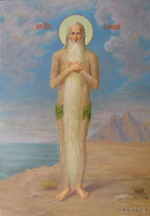
Venerable Mark the Anchorite of Athens​


Saint Mark was born in Athens. He related his life to Abba Serapion who, by the will of God, visited him before his death.

He had studied philosophy in his youth. After the death of his parents, Saint Mark withdrew into Egypt and settled into a cave of Mount Trache (in Ethiopia). He spent ninety-five years in seclusion and during this time not only did he not see a human face, but not even a beast or bird.

The first thirty years were the most difficult for Saint Mark. Barefoot and bedraggled, he suffered from the cold in winter, and from the heat in summer. The desert plants served him for food, and sometimes he had to eat the dust and drink bitter sea water. Unclean spirits chased after Saint Mark, promising to drown him in the sea, or to drag him down from the mountain, shouting, “Depart from our land! From the beginning of the world no one has come here. Why have you dared to come?”

After thirty years of tribulation, divine grace came upon the ascetic. Angels brought him food, and long hair grew on his body, protecting him from the cold and heat. He told Abba Serapion, “I saw the likeness of the divine Paradise, and in it the prophets of God Elias and Enoch. The Lord sent me everything that I sought.”

During his conversation with Abba Serapion, Saint Mark inquired how things stood in the world. He asked about the Church of Christ, and whether persecutions against Christians still continued. Hearing that idol worship had ceased long ago, the saint rejoiced and asked, “Are there now in the world saints working miracles, as the Lord spoke of in His Gospel, ‘If ye have faith even as a grain of mustard seed, ye will say to this mountain, move from that place, and it will move, and nothing shall be impossible for you’ (Mt.17:20)?”

As the saint spoke these words, the mountain moved from its place 5,000 cubits (approximately 2.5 kilometers) and went toward the sea. When Saint Mark saw that the mountain had moved, he said, “I did not order you to move from your place, but was conversing with a brother. Go back to your place!” After this, the mountain actually returned to its place. Abba Serapion fell down in fright. Saint Mark took him by the hand and asked, “Have you never seen such miracles in your lifetime?”

“No, Father,” Abba Serapion replied. Then Saint Mark wept bitterly and said, “Alas, today there are Christians in name only, but not in deeds.”

After this, Saint Mark invited Abba Serapion to a meal and an angel brought them food. Abba Serapion said that never had he eaten such tasty food nor drunk such sweet water. “Brother Serapion,” answered Saint Mark, “did you see what beneficence God sends His servants? In all my days here God sent me only one loaf of bread and one fish. Now for your sake He has doubled the meal and sent us two loaves and two fishes. The Lord God has nourished me with such meals ever since my first sufferings from evil.”

Before his death, Saint Mark prayed for the salvation of Christians, for the earth and everything in the world living upon it in the love of Christ. He gave final instructions to Abba Serapion to bury him in the cave and to cover the entrance. Abba Serapion was a witness of how the soul of the one-hundred-thirty-year-old Elder Mark was taken to Heaven by angels.

After the burial of the saint, two angels in the form of hermits guided Abba Serapion into the inner desert to the great Elder John. Abba Serapion told the monks of this monastery about the life and death of Saint Mark.
 

Attachments

  • 1776517611629.png
    1776517611629.png
    103.6 KB · Views: 29
The Holy Martyr Pausilipos

Commemorated on April 8

The Holy Martyr Pausilipos suffered under the emperor Adrian (117-138). Through denunciation by pagans he was led to trial before the emperor and staunchly declared himself a Christian. They beat him with iron rods and handed over to the governor named Precius, who for a long time attempted to make the martyr offer sacrifice to idols. The martyr remained steadfast, and finally the governor gave orders to fetter him and take him off to execution. Along the way Saint Pausilipos prayed fervently, that the Lord would spare him from the hand of the executioner and send him a quick death. The Lord hearkened to him: the martyr, beaten up and weak, had such a sensation of power, that the iron fetters shattered and freed him from their hold. These were thrown behind him, but Saint Pausilipos died in flight. Christians buried the body of the martyr with reverence.
 
Back
Top