I believe the biggest differences in tone come not necessarily from the speaker mounting (front vs. rear loading), but from the way the cabinets are constructed. There are several videos on YouTube where people recorded the same cab with speakers attached both front and back, and it’s not actually all that different—not compared to the construction of the cab itself.
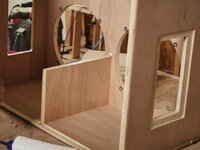
Speaking of which, if you look at internal photos of Diezel FL cabs (their website has some), they have four internal baffles that connect the front to the back, effectively partially isolating the speakers from one another. This is quite unique to Diezel—though Fryette seems similar, or at least sounds similar to my ears. As a result, Diezel FL cabs are incredibly stiff and firmly built, and they are a touch smaller than, say, a Mesa Traditional or a Marshall cab.
Peter Stapfer mentioned that because the parts are CNC-cut, the joints are so tight they can hold together even before any glue or screws are applied. ENGL cabinets are somewhat similar sound-wise, but they achieve that firmness by using thicker wood blanks and less internal baffling. Personally, I’m not a fan of that approach; it makes them a lot heavier and results in a less dynamic sound. In contrast, Diezel cabs feel "alive" yet controlled due to the thinner walls and increased structural stiffness. It seems like they’re much more difficult to build—more parts and more work.
This seems to be the opposite philosophy compared to more traditional designs like Friedman, Bogner, or Mesa Traditional cabs, where the wood resonates a lot more and the construction itself is a lot "looser" to allow for a different type of sound.
I love Diezel FL cabs, but I don’t think they are for everyone. To me, they have a more "HD," refined sound. Even though I’m not a pro audio engineer, I feel like the Diezel FL sounds a lot more like a polished record and requires less EQ tweaking. Usually, I just trim the low-end rumble, cut the super highs to give space for cymbals, and cut some mids (around 700Hz) to free up space for the bass and drums. When I’ve messed with Mesa or Bogner cabs, I always felt they required more EQ tweaking to make them mix-ready.
For some people, Diezel cabs might feel a bit too "metal" or brutal sounding. To that, I’d say when recording, just use something more than an SM57. For example, I blend a Royer R121 with an SM57. The Royer is a ribbon mic with a lot of relaxed lows, so you can just blend them as necessary. In an IR environment, I love to blend a Diezel cab with something like a vintage Marshall with Greenbacks; they are much looser and woody sounding—basically the opposite in spirit. By mixing the two cabs, I can achieve whatever is necessary. Usually, on the Diezel, I go for a 40/60 blend of Royer/SM57 mics, with a 30/70 blend on the Marshall.
If you are familiar with IRs, try to get the Ownhammer impulses—I think it’s called the "Heavy Hitters" library. They have a Diezel cab with both V30 and K100 speakers, so you can see what you like. I actually ended up hating both of those speakers; the V30 is too "stock" sounding (just like everyone else), and the K100 didn’t work for me in real life or in IRs. I eventually swapped them all for Eminence Governor speakers, but that is a very subjective thing.
I don’t know much about the Diezel RL (Rear-Loaded) cabs, but from what I’ve heard, they are similar to regular Bogner cabs—think of them as more refined, "held-together" sounding Marshall cabs. I’d say buy whatever you can find, but I feel the FL is more of the true Diezel sound, whereas the RL is for people who like a traditional response.
Also, I would look up some old threads because Diezel cabs were originally manufactured in Germany before they moved production to the USA and changed makers several times. Eventually, they split production between German and USA-made cabs.