Does flame maple sound different than quilted maple?

  • Thread starter Thread starter Shark Diver
  • Start date Start date
Shark Diver

Shark Diver

New member
I personally don't think so, but I was looking at getting a Tom Anderson Bulldog which is being advertised as a "flame maple top" but has a solid black finish. Why advertise flame maple and then cover it up? Unless you feel flame maple has some advantage tone wise it just seems weird to me. I emailed to find out if it was a typo and was told no it has a flame maple top.

Am I just reading too much into this? :lol: :LOL:
 
Flame maple gives you more of a lineal tone and Curly gives more of a chorus swirl to you tone :D
 
jlbaxe":2jt6w9so said:
Flame maple gives you more of a lineal tone and Curly gives more of a chorus swirl to you tone :D
:lol: :LOL: Yes, I agree!
The Flame Top also gives you a "Hotter, more
Molten Midrange" while the Quilt gives you a warmer,
softer, fluffier Top End that is gentle
enough for every day use.
 
Shark Diver":268g8fzv said:
I personally don't think so, but I was looking at getting a Tom Anderson Bulldog which is being advertised as a "flame maple top" but has a solid black finish. Why advertise flame maple and then cover it up? Unless you feel flame maple has some advantage tone wise it just seems weird to me. I emailed to find out if it was a typo and was told no it has a flame maple top.

Am I just reading too much into this? :lol: :LOL:
If they have a natural wood binding, flame maple looks great.
 
Erock":3l5ewy3r said:
If they have a natural wood binding, flame maple looks great.

beat me to it. that's my guess too and the only thing that makes sense.
 
Shark Diver":3bjyvrqj said:
Am I just reading too much into this? :lol: :LOL:

:yes: Don't read into it too much, it is what it is... Every guitar will sound different, even ones that appear almost identical due to wood density, joinery, etc. Paint, density, grain, and construction all play a role in defining an ax's tone.

But audibly noticing the tone difference between flame and curly? Impossible. AND unfounded and borderline crazy... :no:

V.
 
Ventura":2tirvhyc said:
Shark Diver":2tirvhyc said:
Am I just reading too much into this? :lol: :LOL:

:yes: Don't read into it too much, it is what it is... Every guitar will sound different, even ones that appear almost identical due to wood density, joinery, etc. Paint, density, grain, and construction all play a role in defining an ax's tone.

But audibly noticing the tone difference between flame and curly? Impossible. AND unfounded and borderline crazy... :no:
:thumbsup:
 
It all comes from the same kind of tree, some of the wood is figured and some isn't. :jedi: :force:
 
snowdog":3ebe29v5 said:
It all comes from the same kind of tree, some of the wood is figured and some isn't. :jedi: :force:


i wont get too much into depth here....but where the tree is grown, the climate, humidity, winter seasons (rainy seasons), etc - all has an affect as to how the layers of woods are grown.

healthier trees = more space between the layers. thinner spacings = harder climates, older tree's, hot, cold, and even soil composition become a factor.

just saying that the same type of tree does not mean you will get the same type of wood.

good sounding wood depends on the quality control of the builders....its why anderson, suhr, etc can charge $4,000+ for a guitar/instrument and get away with it.
 
Most quilted maple is soft maple. Some flamed maple can be soft maple too.

Some hard rock maple can be flamed. Hard rock maple and soft maple has very different properties.
 
Here is the link: http://store.mesahollywood.com/090910a.html

Never thought there was a difference in tone between flame and quilted - at least anymore than a difference between woods of even the same cut. I just thought it was funny that it is listed as a selling point when it is being covered up for the most part. I guess the binding does make sense, and it has it. Mucho dinero though.
 
They had a huge stack of flamed maple and used it for the tops...only reason I can see. Its what they had on hand when they started building them or had a surplus of it or its flamed maple, but not quite as nice as what they would use as a "figured" top so use it on these and paint over it.
 
Shark Diver":2t3z578i said:
I personally don't think so, but I was looking at getting a Tom Anderson Bulldog which is being advertised as a "flame maple top" but has a solid black finish. Why advertise flame maple and then cover it up? Unless you feel flame maple has some advantage tone wise it just seems weird to me. I emailed to find out if it was a typo and was told no it has a flame maple top.

Am I just reading too much into this? :lol: :LOL:


That's wierd. I would go over to the Anderson forum ask ask Tom. The dealer or seller may have wrong info.
 
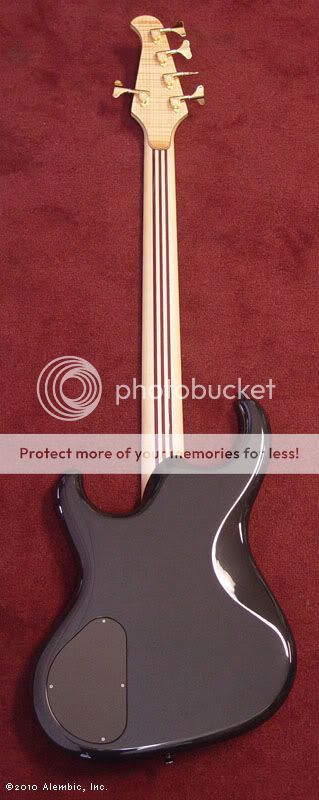
My Alembic bass has a very nice flamed maple top but I had it painted black because I could. :thumbsup:

14121_45viewL.jpg


Also the headstock has a flamed maple cap on the front and back. You can see it on the back.

14121_backviewL.jpg
 
Every piece of wood sounds different as mentioned.
Curly and flamed maple are diseased woods, so each will be different.
There are way too many natural factors to make a blanket statement like that.
Northern woods are denser than southern woods etc due to a slower growth and will tend to be brighter.
Southern trees grow a lot faster and are not as dense.
You could go on and on about a million different factors about the wood, how it's cured, etc.
Play the guitar and see if it sounds good.
I've played guitars made with 80 year old tops and they sounded dead and lifeless, yet were sold as tone machines.
So go figure
 
Ancient Alien":15o8hnm1 said:
Every piece of wood sounds different as mentioned.
Curly and flamed maple are diseased woods, so each will be different.
There are way too many natural factors to make a blanket statement like that.
Northern woods are denser than southern woods etc due to a slower growth and will tend to be brighter.
Southern trees grow a lot faster and are not as dense.
You could go on and on about a million different factors about the wood, how it's cured, etc.
Play the guitar and see if it sounds good.
I've played guitars made with 80 year old tops and they sounded dead and lifeless, yet were sold as tone machines.
So go figure

Do you have any reliable sources to verify that "curly and flamed maple are diseased woods"? Because last I knew, there was no verifiable evidence pointing to the actual cause of most types of figuring. It's all inferred to be from various environmental factors. But there's no actual proof. Something like a spalted maple is from mineral deposits caused by bacteria and fungus in the wood. But a flame/quilt figure (as far as I last knew) was not caused by "disease."
 
Erock":1j60o1ab said:
Shark Diver":1j60o1ab said:
I personally don't think so, but I was looking at getting a Tom Anderson Bulldog which is being advertised as a "flame maple top" but has a solid black finish. Why advertise flame maple and then cover it up? Unless you feel flame maple has some advantage tone wise it just seems weird to me. I emailed to find out if it was a typo and was told no it has a flame maple top.

Am I just reading too much into this? :lol: :LOL:
If they have a natural wood binding, flame maple looks great.

I agree, my main guitar has this and I think it's beatiful. It's a light blue/turquoise top with natural binding and brown sides.. it's so sexy!
 
It's mentioned to let you know that the solid color is not all Mahogany.

They use the maple for the tonal properties it imparts, then paint them solid because they don't make the cut for a trans finish.

I think you're reading too much into the fact they specify flamed.
 
glpg80":ihzu1ny7 said:
snowdog":ihzu1ny7 said:
It all comes from the same kind of tree, some of the wood is figured and some isn't. :jedi: :force:


i wont get too much into depth here....but where the tree is grown, the climate, humidity, winter seasons (rainy seasons), etc - all has an affect as to how the layers of woods are grown.

healthier trees = more space between the layers. thinner spacings = harder climates, older tree's, hot, cold, and even soil composition become a factor.

just saying that the same type of tree does not mean you will get the same type of wood.

good sounding wood depends on the quality control of the builders....its why anderson, suhr, etc can charge $4,000+ for a guitar/instrument and get away with it.

To add to this, there's a thread currently on TGP where Terry Mcinturff talks about the difficulties of using quilt vs. flamed maple tops, and how he gets different quality sound or number of dead pieces per lot and how that varies by flame or quilt. Just judging by that, there's some different quality to be had.
 
Back
Top