Biasing

  • Thread starter Thread starter psmith68
  • Start date Start date
P

psmith68

Active member
Can anyone tell me - when biasing an amp, should the volume and gain be all the way down or maxed out...or somewhere in the middle?

With the volume down, I'm getting a 0 reading, so I'm guessing all the way down is NOT the way to go.

Thanks in advance.
 
When you start applying volume the bias changes, so it won't give you an accurate reading.
 
With the amp on standby you should have a 0 reading. When you turn it off standby (amp on) you should get a reading..you should have your multimeter set at 200m...
 
Thanks for the tips. I have everything reading right but that's raised another question...

I'm trying to bias (2) 6V6 tubes in a Bogner Duende.

Bogner says set the bias to 25ma. One tube is very stable and can be set accordingly, no problem.

The second tube is all over the map with readings as low as 19ma and as high as 32ma without any adjustment to the bias trimpot. (I did adjust the bias to what I thought was close to 25ma but it varies significantly as described).

Does that mean the tube is failing or defective and needs to be replaced??

Thanks again for the informative and spot-on responses.
 
psmith68":3epjm0zt said:
Thanks for the tips. I have everything reading right but that's raised another question...

I'm trying to bias (2) 6V6 tubes in a Bogner Duende.

Bogner says set the bias to 25ma. One tube is very stable and can be set accordingly, no problem.

The second tube is all over the map with readings as low as 19ma and as high as 32ma without any adjustment to the bias trimpot. (I did adjust the bias to what I thought was close to 25ma but it varies significantly as described).

Does that mean the tube is failing or defective and needs to be replaced??

Thanks again for the informative and spot-on responses.
Unstable tube..
 
Is it possible that (2) tubes can share the same bias trimpot?

If so, how could you get an accurate read with a single multimeter?
 
psmith68":1mhmd8hh said:
Is it possible that (2) tubes can share the same bias trimpot?

If so, how could you get an accurate read with a single multimeter?
I doubt that. The output transformer sees a quad of tubes as two pairs where each lead of the OT primary connects to the inside tubes. The outside tubes are then jumped to the inside tubes to make the pair. Some amps with four tubes will have it where you can read the bias of one pair at a time so you double the MA. I have also seen amps that have dual trim pots where the amp has a low and high power. There are two primary leads that come from the OT. In your amp one goes to one tube and the other to the next tube so you are reading one tube at a time when you check them. Switch tubes and you are reading the other one.
 
LP Freak":10lm2n01 said:
Biasing is over rated

Discuss. I'm curious.

Eta: I should've said, I'm curious because I know less than shit about this stuff. But have read that cold bias vs hot does/can effect tone and potentially the innerds of the amp, if too hot/cold.
 
MrDowntown":38k7etwq said:
LP Freak":38k7etwq said:
Biasing is over rated

Discuss. I'm curious.

Eta: I should've said, I'm curious because I know less than shit about this stuff. But have read that cold bias vs hot does/can effect tone and potentially the innerds of the amp, if too hot/cold.
Sarcasm. Proper bias is very important to the tone of the amp and tube life.
 
LP Freak":3lbjvnx2 said:
MrDowntown":3lbjvnx2 said:
LP Freak":3lbjvnx2 said:
Biasing is over rated

Discuss. I'm curious.

Eta: I should've said, I'm curious because I know less than shit about this stuff. But have read that cold bias vs hot does/can effect tone and potentially the innerds of the amp, if too hot/cold.
Sarcasm. Proper bias is very important to the tone of the amp and tube life.

Ahh...my sarcasm detection system is OFT on Sunday's. ;)
 
MrDowntown":3usowqhz said:
LP Freak":3usowqhz said:
Biasing is over rated

Discuss. I'm curious.

Eta: I should've said, I'm curious because I know less than shit about this stuff. But have read that cold bias vs hot does/can effect tone and potentially the innerds of the amp, if too hot/cold.
Some amps sound better with a little colder bias and Vice Versa. I usually pick a few points and listen at each bias and decide which I like.
 
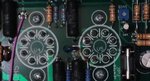
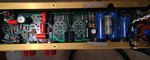
If you look at the photo here, you can see the underside of (2) tube sockets (6V6's) but only (1) bias trim pot.

Bias trim pot is to top right.
 

Attachments

  • IMG_3682.jpg
    IMG_3682.jpg
    163.7 KB · Views: 1,652
  • IMG_3677.jpg
    IMG_3677.jpg
    1,022.6 KB · Views: 1,689
Wow, my Duende has 2 pots, one for each tube, also they Bogner told me to bias to 28mA minimum up to 34mA on the JJ's that are in my amp which I thought was high, about 85% if you do the math but I know the JJ 6V6's are able to take a hotter bias and are at least a 14-16 watt tube. Sounds great so...mine is a newer Duende so that could be the difference.
 
Usually there is just one trim pot, even for a 100 watt amp. Sometimes the other "trim pot", is actually a hum balancer and should not be mistaken for a Trim Pot. But if your manual says it has 2 Trim Pots then that's fine. Sound like one of your tubes is acting up.
 
Bogner tells me that as long as you have a set of matched power tubes, you can bias both tubes off a single trim pot.

They also tell me they bias the tubes at the factory using a signal generator and scope...whatever that means. (I can't imagine most local tech's are doing the same...hopefully I'm incorrect).

Unfortunately, one person with Bogner told me to bias at 25mA and another said 28 - 32mA.
 
The pot will raise or lower the bias of both tubes. I was talking about bias test points where you would read the MA of two tubes combined.
 
You're overthinking this.

The vast majority of amps out there only have one bias trim pot for all the tubes. Some have individual bias pots per tube or per pair of tubes. Do not confuse "bias trim pot" with "bias test point." They are two different things. Some amps have bias test points, some do not—and the bias must be read off the tube socket directly or from using another method (like the shunt technique).

Regardless, in your situation it seems like you either have a bad tube or something wrong at the socket of the tube that's acting up.

I would start by swapping the two tubes around. If the fluctuating bias problem follows the same "bad" tube to the new socket, you will confirm that it's the tube that's bad. If the "good" tube is now fluctuating when you swap the tubes around, you know it's a problem with the tube socket.

As far as the actual bias setting you should use, follow this chart: http://www.webervst.com/tubes1/calcbias.htm (look at the chart for 6V6). Measure your amp's actual plate voltage and the chart will tell you the correct bias range. Bias is a personal preference. As long as it's within the range for your amp's voltage, you should be fine.
 
Back
Top