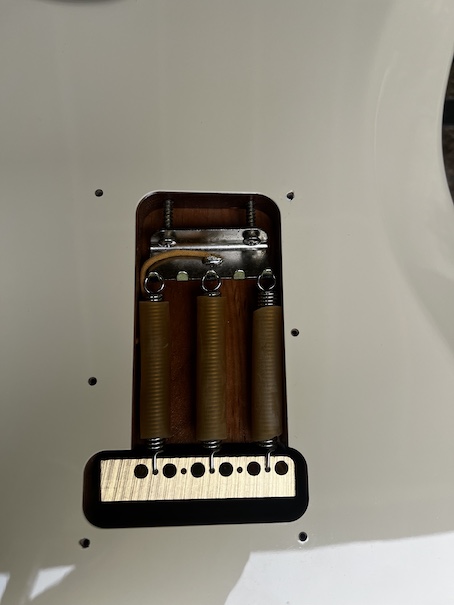
Brass trem block

  • Thread starter Thread starter Scot
  • Start date Start date
S

Scot

Active member
Took some time last week to make a chunky brass block for my stock trem (player 2 HSH strat). Not trying to fix anything, just curiosity. The finished block’s about 50% heavier than the oem zinc block (12oz vs 8oz).

Without diving into every nuance, there’s alot to like after installing the brass block. Particularly what seems an upper mid bump using high gain that’s really nice. Trem arm’s no longer floppy and there’s considerably less vibration through the guitars body using the heavy block so more energy to the strings, definitely. Great sustain & more chime from an already chimey guitar, so check - physics works.

Guitar sounds terrible splitting the hb’s but really good using the full neck hb, especially playing clean. The bridge hb using lots of gain - bass is good, highs are good and upper mids are great but it scooped the lower mids b/c they are gone. Gone to the extent it’s like using a similar but different pickup in the bridge altogether. Playing chords especially is just hollow sounding & there’s virtually no body or punch compared to the zinc block. Amp tweaks help but it sounds unnatural and forced trying to use bass to put muscle back into what I perceive to be lean (but familiar) low mids. Maybe the block’s too heavy and some fine tuning’s warranted but most likely it’s back to the zinc block for me. Definitely interesting and not quite what I expected. Also of course, YMMV.

Now I can’t help wondering what block saddles (made from billet brass) would do instead of switching out the zinc block. Maybe a brass nut would be a less dramatic means of getting a little upper mid bump? All comments welcomed.
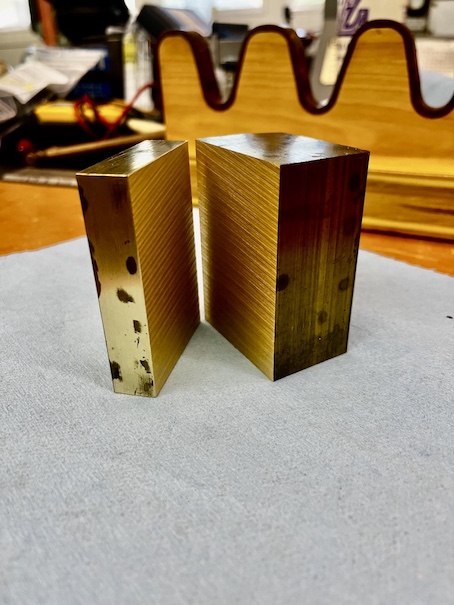
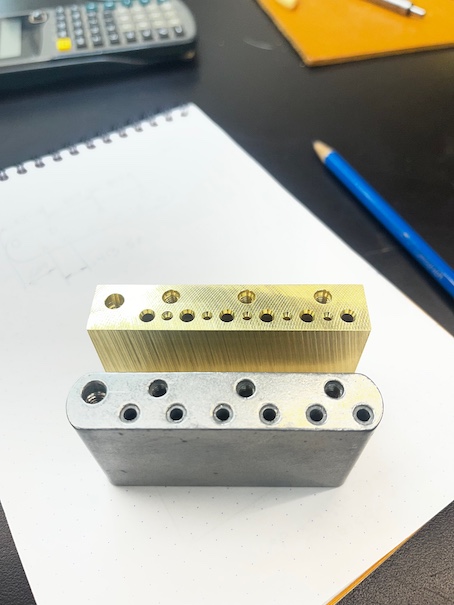
1.jpeg
2.jpeg
3.jpeg
 
Very cool experiment, thanks for sharing it here.

I think the PRS core series uses brass blocks and saddles and I have never heard anyone make those claims vs an SE that uses zinc or whatever for the block. Also interesting is they use an ultra lightweight tailpiece (zinc I think) for the stop tails. I swapped from heavy grovers to a lightweight vintage kluson and felt the tone was improved, i.e it opened up slightly, though it wasn't something you'd immediately recognize while plugged in in a band setting. PRS seems to have made the same move so I guess I wasn't just imagining stuff.

Maybe you should take the rubber offa the springs and see what happens before you switch back....
 
Interesting topic....I've messed with different blocks and I agree....sometimes a brass block sounds good and in some guitars not. Same with tungsten...I had a guitar (alder strat) that it sounded terrible in and yet sounded great in a different guitar (basswood with a maple cap).
BTW Scot...did you machine that yourself? nice clean work if so. Drilled spring holes and trem arm holes at an angle?
Oh and for my two cents a brass nut is not worth the trouble...hard to cut, only affects open strings anyway and strings bind up in the slots more than other traditional (bone) materials.
 
Me neither....but I love the Fralin partial split mod. I use a little trimpot and dial it in to taste.
The EMG 89 splits into a stacked single coil, that's a pretty cool thing. Not exactly a single coil but the stacked single sounds almost single and really useful.
 
EMG 89....different beast. I was talking about a partial split on a passive humbucker.
 
  • Like
Reactions: Geo
Very cool experiment, thanks for sharing it here.

I think the PRS core series uses brass blocks and saddles and I have never heard anyone make those claims vs an SE that uses zinc or whatever for the block. Also interesting is they use an ultra lightweight tailpiece (zinc I think) for the stop tails. I swapped from heavy grovers to a lightweight vintage kluson and felt the tone was improved, i.e it opened up slightly, though it wasn't something you'd immediately recognize while plugged in in a band setting. PRS seems to have made the same move so I guess I wasn't just imagining stuff.

Maybe you should take the rubber offa the springs and see what happens before you switch back....
You’re welcome - thanks for your comments. They’re helpful and jive w/something I read while interwebing (ie: PRS (and maybe others) use a skinny brass block). Not only did I re-install the surgical tubing on all springs vs leaving one spring bareback (like normal), but I also snipped short tapered pcs of wool and snaked them through the inside of the springs also. More energy to the strings, also means more energy to the springs, so there’s that. Further, new strings, so there’s that too. Nonetheless, you’re spot on. After my first amp session with it, and hearing the results, I spent some time floating the trem just right and also tightening the saddles up & checking intonation. Even with all the guitar tweaks, there’s still something just not sounding right..like some dissonance between the a & d string which cancels out a frequency or something - no bark between those two strings played together. When it comes to gain, no question, less is more and single notes sound fat, just not meaty. For a “pretty” sounding strat, this block's kinda the ticket (notwithstanding the a & d string weirdness).

Interesting topic....I've messed with different blocks and I agree....sometimes a brass block sounds good and in some guitars not. Same with tungsten...I had a guitar (alder strat) that it sounded terrible in and yet sounded great in a different guitar (basswood with a maple cap).
BTW Scot...did you machine that yourself? nice clean work if so. Drilled spring holes and trem arm holes at an angle?
Oh and for my two cents a brass nut is not worth the trouble...hard to cut, only affects open strings anyway and strings bind up in the slots more than other traditional (bone) materials.
Great info, thank you. It immediately reinforces that a guitar is the sum of all parts and Fender’s got these guitars at certain price points pretty well engineered. When you consider that a “strat” is basically a mechanism just laid in a cradle (the planks of wood), the mechanics get easy real fast. I did do all the machining, thank you for the nice compliment. The spring holes and trem hole are indeed drilled at an angle. Both at approximately 12.5º. Good mechanical leverage and springs don’t pop out of holes that way. I bend my trem arm to suit, but truthfully don’t use it much. Now that it fits the way it should, I suspect that might change. As machined, the trem will loosen with time, but I have a simple mod in-mind. Great advice, and thank you for the comments about a brass nut, because I’m pretty sure that’s where I was headed. I’ve never in my life cut a guitar nut and it sounds like brass isn’t the best to place to start. I have a steady hand, but I’m getting f'ing old, so there’s that. Plus, I don’t have all the right files.
Never found the sound of a humbucker split to sound like a good single coil., maybe you are just hearing it better with the brass block?
I could never ever pretend to know a good single coil to a bad one. I do know my coil splits sound pretty good and all pickups (and positions) work well together using the zinc block. I’ve come to really appreciate what a single coil sounds like, especially clean and at some point in the future I foresee a owning a second strat that’s true blue strat, if for the cleans alone. There’s also some pretty big caveats here - I’m just a guy playing to a 4x12 in a good spot where my amp sounds good. No other instruments and I don’t often use effects. Moreover, I’m hardly an accomplished player or musician. I’m happy to play along with Victim of Changes to try and nail Glenn Tipton’s style while also learning some Maiden songs to play along with. My wife says everything I play sounds evil and I don’t know how to play anything pretty, so lately I've been learning Dreamer/Deceiver, Children of the Damned and the intro to Into the Coven by Mercyful Fate. All pretty easy, excluding solos (for me). I’ve had my amp a long time and know it well. I also now know my strat pretty good - that takes awhile.
 
My wife says everything I play sounds evil and I don’t know how to play anything pretty, so lately I've been learning Dreamer/Deceiver, Children of the Damned and the intro to Into the Coven by Mercyful Fate. All pretty easy, excluding solos (for me). I’ve had my amp a long time and know it well. I also now know my strat pretty good - that takes awhile.
Get yourself an acoustic, it will improve your playing and make your wife happy.
 
My wife says everything I play sounds evil and I don’t know how to play anything pretty, so lately I've been learning Dreamer/Deceiver, Children of the Damned and the intro to Into the Coven by Mercyful Fate.
You should print out a lyric sheet for Into The Coven and have your wife sing along while you play.
 
You should print out a lyric sheet for Into The Coven and have your wife sing along while you play.
For the folks that don't know this metal classic -

Howl like a wolf
And a witch will open the door
Follow me and meet our high priestess

Come, come into my coven
And become Lucifer's child

Undress until you're naked
And put on this white coat
Take this white cross and go to the middle of the ring

Come, come into my coven
And become Lucifer's child

Now crush it, crush the cross
Suck the blood from this unholy knife
Say after me, my soul belongs to Satan

Now, now you're into my coven
You are Lucifer's child
Into the coven Lucifer's child
 
After a week I’m liking everything about the heavy brass block - chime is fantastic & sustain is just ridiculously good. The block weighs 345 grams against the stock zinc block at 234 g. Bass & treble's arguably better than the zinc block but those hollow low mids are annoying, but mostly affected using distortion. Therefore one last round of testing amongst some more blocks I whipped-up. I made one skinny brass (258g), one fat Aluminum (145g), one fat Stainless (345g) and one out of tool steel @ 268g. Need some strings.

blocks.jpeg
 
After a week I’m liking everything about the heavy brass block - chime is fantastic & sustain is just ridiculously good. The block weighs 345 grams against the stock zinc block at 234 g. Bass & treble's arguably better than the zinc block but those hollow low mids are annoying, but mostly affected using distortion. Therefore one last round of testing amongst some more blocks I whipped-up. I made one skinny brass (258g), one fat Aluminum (145g), one fat Stainless (345g) and one out of tool steel @ 268g. Need some strings.

View attachment 445240
Those look awesome. You got skills! Can't wait to hear more of your feedback with this.
 
Thanks, man - that’s kind of you to say.

I watched a youtube video hosted by what appears to be a nice fella who’s tried several blocks. Most notably blocks replicating 60’s Fender hardware. The takeaway from that video for me is that a steel block weighing 280g +/- seems to be the Fender way. I call bs on “bell brass” because, what exactly is that? (hint: it’s marketing me thinks). I used Navy brass, or more specifically cartridge brass (70%copper 30% zinc), for my blocks. As detailed in my most recent update I also made one from steel that’s close to 280g but it’s not “cold rolled”, it’s unhardened O1 tool steel. I also have a nice chunk of bronze but it’s bearing bronze and impregnated with oil so can’t imagine that would be a good choice. Nothing scientific here, just in the room impressions and I’m happy to share. I’ll be sure to update as I try the different blocks.

 
I call bs on “bell brass” because, what exactly is that? (hint: it’s marketing me thinks). I used Navy brass, or more specifically cartridge brass (70%copper 30% zinc), for my blocks
It's not marketing, it's a different alloy. It's more bronze than brass. It might be worth tracking some down for your experiment since you are being exceptionally thorough with this testing, which quite honestly, is absolutely killer for you to do it, and to be sharing the findings here. Bronze/bell brass is likely more costly, but also might be the missing link in terms of those hollow low mids you mentioned. I have worked with a drummer with a bell brass black beauty copy and it was quite loud but also warm without any harshness. Just a thought....

One thing I can say having been spending some time with trumpet/cornet/flugelhorns is the bell material makes a large difference in the tone especially when you get the bell sizzling. I have a 50's Conn 12a cornet with what is called a "coprion" bell. It's actually 100% pure copper, called "coprion" because it was electroformed using copper ions around a mandrel instead of the usual hammering/shaping process. Long story short there is a level of warm fuzziness to the sizzle vs a standard brass bell which is quite a bit brighter and strident, the usual formula for trumpets/cornets/flugels being that cartridge brass alloy 70/30 you mentioned, with some variations per specific horn models and manufacturers.
 
Scot, I thought this video below might be helpful or at least offer some additional insights for your research. I notice philadelphia luthier offers a full bell brass Nashville TOM bridge....you're sending me down a rabbit hole, LOL.
 
Fat brass was cool, but I'm convinced it's too heavy. I could get really cool grindy tones from it but there's an omnipresent metallic fizz and it lacks body. Cleans are beautiful & sustain is just incredible (eg: notes/chords don't decay & sustain rings long time).

Aluminum's next - this one's fat and about all I could stuff through the top of the guitar. Trem is limited to a step-1/2 down, so judicious shaping's in order. 144 gr's (5+ oz) - initial impression: NICE! Sounds instantly similar to the zinc block but brighter. Great clarity and really bright, but in a really sweet way despite being a little plinkier. Sounds beautiful clean and really rewards a soft touch - very delicate sounding. Under lots of gain, the nastiness is back in the mids, so check. Might be a little thinner sounding overall, but solid nonetheless.

This might be the block to beat.

trem.jpeg
fat alum.jpeg
 
It's not marketing, it's a different alloy. It's more bronze than brass. It might be worth tracking some down for your experiment since you are being exceptionally thorough with this testing, which quite honestly, is absolutely killer for you to do it, and to be sharing the findings here. Bronze/bell brass is likely more costly, but also might be the missing link in terms of those hollow low mids you mentioned. I have worked with a drummer with a bell brass black beauty copy and it was quite loud but also warm without any harshness. Just a thought....

One thing I can say having been spending some time with trumpet/cornet/flugelhorns is the bell material makes a large difference in the tone especially when you get the bell sizzling. I have a 50's Conn 12a cornet with what is called a "coprion" bell. It's actually 100% pure copper, called "coprion" because it was electroformed using copper ions around a mandrel instead of the usual hammering/shaping process. Long story short there is a level of warm fuzziness to the sizzle vs a standard brass bell which is quite a bit brighter and strident, the usual formula for trumpets/cornets/flugels being that cartridge brass alloy 70/30 you mentioned, with some variations per specific horn models and manufacturers.
Fat aluminum block remains installed (because it sounds good) and I still haven’t ordered strings to try different blocks. I reworked the fat brass block targeting 280grams and it came out great. Also working on another pile of blocks.

While deep in this hole it naturally occurred to me saddles can be changed without changing strings, so I made block saddles. Three sets - one each made from ‘Ordnance’ Brass, Copper & Aluminum. I couldn’t source such a thing as ‘bell brass’, but VB, thank you for educating me on “bell metal” (available in ingots). That’s legit af actually, but it is bronze (ie: copper/tin).

Further, after reading your description of the electroforming process used to create horns (and presumably other complex shapes) I immediately decided to make saddles from C110 oxygen free copper - it’s 99.9% pure. It machines like bubble gum and they look awful on my guitar but they sound pretty amazing with the aluminum block, plus, they will age beautifully.

I’m honestly pretty blown away after spending a good bit of time playing yesterday. In sum, the fat aluminum brings brightness & articulation without fizz and the copper brings the bells with solid lows. Compared to the bent steel saddles, my lows seem tighter, upper mids are glorious, meaty raunch is there and highs are slightly rolled-off, but still sweet w/bite. Most notable change overall is the quick attack and percussiveness I’m getting (especially appreciated using lots of distortion)..that’s new. Acoustically the guitar’s always been better than good, now it’s over the top good and also sounds amazing through my clean channel in all pickup positions. We’ll see after a few days if my initial impressions stick. It’s quite a bit different than my stock guitar overall and it’s been a trip to really hear the differences first-hand while essentially re-building the stock trem using legit machined hardware. The additional mass of copper/block vs bent steel only makes already good sustain from the aluminum block just better (fuller).

2.jpeg
3.jpeg
4.jpeg
 
Back
Top