Diezel Einstein baked solder joints?

  • Thread starter Thread starter Ravager1663
  • Start date Start date
R

Ravager1663

New member
Hi,
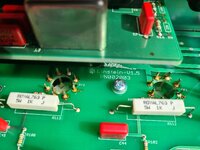
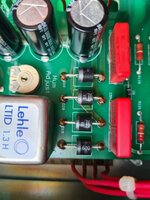
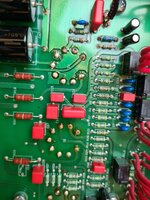
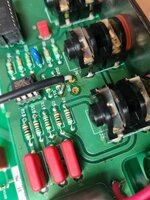
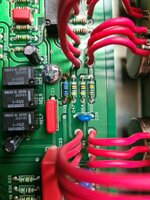
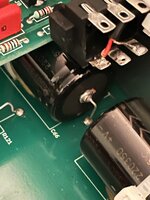
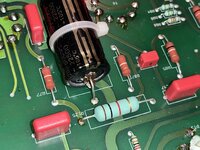
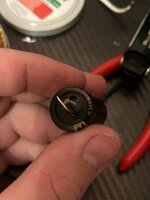
In my Einstein, I saw a lot of solder joints of the tubes and other areas that look somewhat concerning to me.
It looks somewhat "cooked"; are these signs of resoldering with an improper soldering iron or the use of soldering flux?
Can anyone please tell me whether there could be a problem with the Einstein and whether I should take it to a tech?
I just got it a few weeks back and don't have any information on whether it had professional or non-professional repairs in the past.
Thank you in advance

Edit:
I added one more picture that shows new solder joints on R38, as well as on one or two other resistors or small caps. Is it maybe possible that the previous owner made modifications to the Einstein and maybe even messed this up, and that's why many of the connections look like they got too much power, or, respectively, wrong current or voltage values?
Any opinion about what this looks like is much appreciated.
 

Attachments
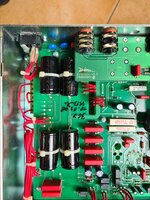
  • 20260902_151049[1].jpg
    20260902_151049[1].jpg
    2 MB · Views: 74
  • 20260902_151147[1].jpg
    20260902_151147[1].jpg
    1.2 MB · Views: 64
  • 20260902_151326[1].jpg
    20260902_151326[1].jpg
    1.3 MB · Views: 64
  • 20260902_190925[1].jpg
    20260902_190925[1].jpg
    1.7 MB · Views: 61
  • 20260902_191833[1].jpg
    20260902_191833[1].jpg
    1.4 MB · Views: 68
  • 20260902_191754[1].jpg
    20260902_191754[1].jpg
    1.5 MB · Views: 62
Last edited:
The amp looks fine to me but I am not a certified Diezel repair specialist and don’t claim to be one. What’s pictured looks like residual flux.

If something is wrong, or the amplifier is not operating correctly, please take it to a certified Diezel repair specialist.
 
I just ordered new tubes and will see what happens.
Testing the amp so far; everything seems okay.
I just wonder where such a mess of flux residue can come from, and I am a little bit concerned that the solder joints could be not far from getting faulty.
The solder on the "Zener diodes?" looks really bad, imo.

I found this on a website:
Corrosion:
Some fluxes contain aggressive chemicals that can cause corrosion on assembly surfaces. This can result in deteriorated solder joints, metallization, or other components, ultimately reducing the lifespan of the assembly.

The solder joints of the power tubes look like teeth that were in a Coca-Cola; it looks like there is not much material left.
I just want to show this instead of just resoldering all the points, in case it shows that something is wrong. :)
 
Last edited:
Hey,
Thanks a lot for the help.
There are still a few things that I don't understand about the whys, but I am no expert and so I will just accept it. 😉
On a few Pins of the Power tubes is very little solder and there is so much mess around the parts that it overall hardly fits the perfect manner in which the layout was executed. So, I really was sure that this was done by a non professional. :P

There is no problem if I resolder all the points, right?
Cleaning of the joints and the pcb with isopropyl I have already done.
Thank again for your answers.
 
It’s all good, it’s just flux from soldering. If it’s really bothering you, you can wipe it off with isopropyl alcohol. But really, if you don’t know about flux and the fact that it’s completely normal, you’re better off staying away from an open chassis. There are some very high voltages in there that can hurt or even kill you.

If you really care about the amp, you’re better off visually inspecting the filter caps (those big black barrels with gold lettering) for leakage, corrosion, or deformation.( don’t touch them)

Einstein isn’t a new amp. These filter caps typically last around 20 years. On my Herberts, I noticed they’ve started to leak a little (although the amps still work and sound fine), so I’m waiting for FedEx to bring the replacements. For the Herbert, it’s about €70 worth of parts and maybe an hour of work—no big deal for 20 years of service.

It’s kind of like changing the oil in your car, just a lot less often and a lot cheaper. :)
 

Attachments

  • IMG_0389.jpeg
    IMG_0389.jpeg
    955.6 KB · Views: 44
  • IMG_0366.jpeg
    IMG_0366.jpeg
    2 MB · Views: 43
  • IMG_0370.jpeg
    IMG_0370.jpeg
    899.6 KB · Views: 47
It’s all good, it’s just flux from soldering. If it’s really bothering you, you can wipe it off with isopropyl alcohol. But really, if you don’t know about flux and the fact that it’s completely normal, you’re better off staying away from an open chassis. There are some very high voltages in there that can hurt or even kill you.

If you really care about the amp, you’re better off visually inspecting the filter caps (those big black barrels with gold lettering) for leakage, corrosion, or deformation.( don’t touch them)

Einstein isn’t a new amp. These filter caps typically last around 20 years. On my Herberts, I noticed they’ve started to leak a little (although the amps still work and sound fine), so I’m waiting for FedEx to bring the replacements. For the Herbert, it’s about €70 worth of parts and maybe an hour of work—no big deal for 20 years of service.

It’s kind of like changing the oil in your car, just a lot less often and a lot cheaper. :)

The Einsteins did have a bad batch of filter caps at one point. I had to replace them in the Einstein combo I had years ago, per Diezel's recommendation.
 
Back
Top