How to properly record on a daw with interface.

  • Thread starter Thread starter S̷͖͑m̵͎͂á̵̺s̸͚̈́h̴̬̑
  • Start date Start date
S̷͖͑m̵͎͂á̵̺s̸͚̈́h̴̬̑

S̷͖͑m̵͎͂á̵̺s̸͚̈́h̴̬̑

Hack
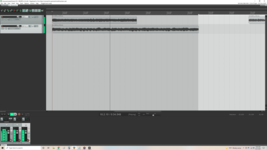
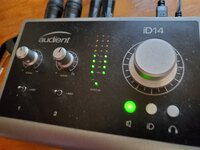
Ok. This is something I should have asked a long time ago. I record my shitty clips a lot. However, I sometimes hear a clipping that i don't see in the interface. Even that is a bit off topic. I use reaper. So I have the faders at the bottom left. Then I have the gain on the interface itsself. So I think my goal should be to use the faders afterwards to lower the signal if i am mixing tracks...I record between 103 and 107 decibels. Should I want the faders on reaper up high and gain on interface lower? Any other tips? I have been using two mics lately cuz it gives me a more rounded sound. But Sometimes I just like the cut of a close mic. But i just don't really know what I am doing. I am just doing it as hard as I can..lol.

this is the latest clip i made on sound cloud with both mics active. I have been trying to max gain to point of clipping between faders and actual gain pots on interface. I make sure that between the master and the actual track, I am as high on level as i can be before i get to red. Is this right? By the way, this clip is a simple little clip, and I dont need comments on my shitty playing, lol, just the actual recording of it.
 

Attachments

  • interface.jpg
    interface.jpg
    3.2 MB · Views: 117
  • reaper.png
    reaper.png
    77.6 KB · Views: 69
The key thing to understand here is that the old-school methodology of gain structure doesn't apply anymore when it comes to interface-input levels, mate.

Back in the day we all had to maximise levels just short of clipping (unless that effect was desired) in order to retain the best-possible signal-to-noise ratios. Not so anymore. Modern interfaces' dynamic range tends to be in the 100->120dB range, meaning that the noise floor in 24-bit interfaces is super-low.

The result is that we can, in your example of instance, set the interface-input level to peak at -12dB or less without worrying about the odd stray spike / level peak clipping it.

This means that, once your input levels are set low like this, you should be able to run the signal through your DAW at unity gain (no boosting or cutting) and your guitar levels will be around about what you heard whilst recording. A handy starting point.

The take-home message is not to worry about maximising track levels at any point during recording and playback. Evening out levels is another matter and it's important with bass and vox for example, but that's got nothing to do with maximising gain in order to minimise the noise floor; that's old-school and not necessary anymore.

HTH mate.
 
The key thing to understand here is that the old-school methodology of gain structure doesn't apply anymore when it comes to interface-input levels, mate.

Back in the day we all had to maximise levels just short of clipping (unless that effect was desired) in order to retain the best-possible signal-to-noise ratios. Not so anymore. Modern interfaces' dynamic range tends to be in the 100->120dB range, meaning that the noise floor in 24-bit interfaces is super-low.

The result is that we can, in your example of instance, set the interface-input level to peak at -12dB or less without worrying about the odd stray spike / level peak clipping it.

This means that, once your input levels are set low like this, you should be able to run the signal through your DAW at unity gain (no boosting or cutting) and your guitar levels will be around about what you heard whilst recording. A handy starting point.

The take-home message is not to worry about maximising track levels at any point during recording and playback. Evening out levels is another matter and it's important with bass and vox for example, but that's got nothing to do with maximising gain in order to minimise the noise floor; that's old-school and not necessary anymore.

HTH mate.
that is interesting. in my case, though, i am running a mic into interface, not guitar signal. Same principal apply, I suppose?
 
Yup. It's the philosophy of not trying to maximise input levels without clipping as we did in the "old" days. Any analogue source.

Let's face it, it wasted a lot of time, trying to tweak every input so that the highest-possible signal could be recorded without going into the red. Often that was what you wanted anyway with tape, but as you'd know, digital is not forgiving and the ceiling is "0", so trying to get close to it without risking "overs" is practically-impossible.
 
I am such a dipshit when it comes to this stuff. I appreciate the help.
 
No worries, brother! :LOL:

I think I should stress again that the reason we now have the freedom to set input levels so low (-12dB and below - even -20dB isn't silly) is that the noise floor in modern interfaces is very-low. LP's were around -60dB, cassette -65-70dB, reel-to-reel tape up to, I'm guessing, 90dB for the high-end studio stuff running fancy Dolby noise reduction, and yet here we are with interfaces well beyond -100dB for budget stuff, around -120dB for midrange gear and close to -130dB for the high-end stuff.

That's a huge difference in background-noise level, no? See why 12 to 20dB is easy to sacrifice now? You'd have to crank your interface's inputs a long way before you'd hear any noise. That's why the philosophy works... that and the fact that 24 bit means that there's plenty of resolution available for lower levels, but don't worry about that; it's not necessary to know the whys and wherefores, just that it sounds equally-good at much-lower input levels.
 
Last edited:
I record my Larry at 110 db ish in the live room, and endgoal is between -12 and -6 on the daw. But like monkey says with modern noise floors even -20 is reasonable.
 
I record my Larry at 110 db ish in the live room, and endgoal is between -12 and -6 on the daw. But like monkey says with modern noise floors even -20 is reasonable.
Indeed, Dan.

In fact, if you're operating in a 6B range, as it seems you are, I'd recommend bringing that down to peak at -12dB, so a -18 -> -12dB range.

With -6dB you're starting to get into territory that risks inter-sample overs, for one thing.
 
Indeed, Dan.

In fact, if you're operating in a 6B range, as it seems you are, I'd recommend bringing that down to peak at -12dB, so a -18->-12dB range.

With -6dB you're starting to get into territory that risks inter-sample overs, for one thing.

It does risk it, certainly, but at long as there are no audible effects, it's fine for my "song demo" type purposes with my normal home recording setup.

If I am engineering someone's record, or even my own, i would 10000% heed your advice though on it though. That's a gamble I'm not willing to take when time is money.
 
Ya, always err on the side of not coming even close to hitting red when it comes to recording digital.
imo
 
Well I appreciate it guys. I can definitely set the faders to -12, but then I have the input gain on the interface itsself. What to do with it?
 
That's what I've been talking about mate - adjusting the input gain for that -18 -> -12dB range.

What you do with your mixing faders has no bearing on how hard your signal hits those A/D (input) convertors.
 
Shifting this thread to the Rig Talk sub-forum; it doesn't belong in the video-clip area and would benefit more members if moved.

EDIT 1
Oh poo. Will have to wait for mod status in this sub-forum, but have put in the request and will get onto it ASAP...

EDIT 2
OK, super moderator now, so can move it to where it belongs...
 
Last edited:
Back
Top