New member with tube question

  • Thread starter Thread starter BlueTele
  • Start date Start date
B

BlueTele

New member
Hey everyone- new to the forum. Been playing off and on for 32 years and had a question regarding microphonic tubes.

I have a Victory preamp pedal (The Jack V4). I found the valve in position V2 is pretty microphonic to my ears, ringing a bit when I switch channels to channel 1. I opened up the chassis and tapped on the tubes with a wooden stick and there’s a mild ringing when tapping any of the tubes, but it really sings on the V2 tube. Victory said it’s normal, but it seems pretty excessive to me. Wondering how hard to fight for new tubes, as they are supposed to have a 2 year tube warranty on the CV4014 tubes.

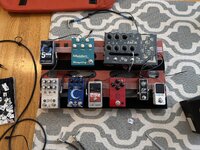
Posting a pic of my main pedalboard, too.

Thanks.
 

Attachments

  • IMG_3115.jpeg
    IMG_3115.jpeg
    3.2 MB · Views: 107
Hey everyone- new to the forum. Been playing off and on for 32 years and had a question regarding microphonic tubes.

I have a Victory preamp pedal (The Jack V4). I found the valve in position V2 is pretty microphonic to my ears, ringing a bit when I switch channels to channel 1. I opened up the chassis and tapped on the tubes with a wooden stick and there’s a mild ringing when tapping any of the tubes, but it really sings on the V2 tube. Victory said it’s normal, but it seems pretty excessive to me. Wondering how hard to fight for new tubes, as they are supposed to have a 2 year tube warranty on the CV4014 tubes.

Posting a pic of my main pedalboard, too.

Thanks.
Send them a video of it. They may think you are complaining about hearing the taps, which is normal. You are hearing ringing though, which sounds like a microphonic tube to me. Just record a clip of it 'singing' and they will probably ship a replacement.
 
Hey everyone- new to the forum. Been playing off and on for 32 years and had a question regarding microphonic tubes.

I have a Victory preamp pedal (The Jack V4). I found the valve in position V2 is pretty microphonic to my ears, ringing a bit when I switch channels to channel 1. I opened up the chassis and tapped on the tubes with a wooden stick and there’s a mild ringing when tapping any of the tubes, but it really sings on the V2 tube. Victory said it’s normal, but it seems pretty excessive to me. Wondering how hard to fight for new tubes, as they are supposed to have a 2 year tube warranty on the CV4014 tubes.

Posting a pic of my main pedalboard, too.

Thanks.

Welcome to Rig-Talk and enjoy your stay
I'm not the brightest bulb here but...
You should always have at least 1 known good tube back up (pre and power)
I've never even heard of this tube (CV4014) but I see it is real on google
So buy one, so you can prove it to yourself and them that the tube went microphonic
If you can afford it, get a NOS version so there is really no question
Also rotate that known good one around until you get the best tone
Use Dioxit or similar to spray and lube the pins before insertion (like once a year)

Edit: I mostly agree with @Music&Chaos except if you hear tapping coming through the speaker - that 'can' also indicate microphonics. In other words, I do not consider that normal.
 
Tubes are a good thing to have laying around anyways. Sounds like you might need some. I can see Victory not doing a warranty on michrophonic tubes considering it's a pedal. Technically the tubes still work. It sucks, but you won't regret having preamp tubes on hand for it.
 
welcome aboard RT

having a extra tubes around is like the spare tire in your trunk. you'll never need it until you do

not sure what tube you have but of they're all the same family 12AX7 12AT7, 6L6 5881, El34 6CA7, etc you can roll them around to isolate the bad one
 
Welcome to Rig-Talk and enjoy your stay
I'm not the brightest bulb here but...
You should always have at least 1 known good tube back up (pre and power)
I've never even heard of this tube (CV4014) but I see it is real on google
So buy one, so you can prove it to yourself and them that the tube went microphonic
If you can afford it, get a NOS version so there is really no question
Also rotate that known good one around until you get the best tone
Use Dioxit or similar to spray and lube the pins before insertion (like once a year)

Edit: I mostly agree with @Music&Chaos except if you hear tapping coming through the speaker - that 'can' also indicate microphonics. In other words, I do not consider that normal.
Depends on the amp design - tapping near a tube near the input and hearing the tap through the amp can be completely normal.
 
All tubes are microphonic due to their design. Manufacturers of tubes such as New Sensor or RCA who invented the 12AX7 will tell that to you.

https://www.tungsol.com/html/faqs18.html

It becomes a matter of preference and tolerance where it might be too microphonic for you but maybe to someone else its perfectly acceptable. Maybe that tube performs too microphonic in that piece of gear for you in that position but in another piece of gear or another position it could be fine. Try not to think of microphony as black and white but shades of grey.

If you'd like to see variations in tube measurements go on ebay and type 12ax7 maxi for example. People will post the measurements of tubes and you can see the variations for gain, transconductance and noise. There's no measurements for microphonics but it'll give you ideas that tubes are in ranges and not just a static number ie 12ax7 = 100 gain.
 
I'd never heard of that tube, either, so I looked it up. The CV4014 is not related to any of the common 12A*7 types. Not sure they even make them anymore, so they all may be NOS. As a military tube type, they were designed to be used in environments of high vibration, so I would think that being overly microphonic is out of the norm for these. The good bit is that they seem to be cheap, if you can find them, like in the $5-10 range. Looks like that pedal uses 3 of these.

The other tube in that pedal is an EC900, another I'm not familiar with and another uncommon type. Likely would have to be NOS, too, but again, cheap in the same $5-10 range.
 
The tap method may have worked in the 60's but in my experience is not a very good indicator.
 
The tap method may have worked in the 60's but in my experience is not a very good indicator.
Tapping valves when hot just causes more problems.

Military spec valves and audio are a bad mix.

Victory’s stock valves are utter dogshit.

Unless you are prepared to visit Victory and grab them by the throat - don’t expect any aftersales support.
 
Why are military spec valves and audio a bad mix?
View attachment 453545
Let’s take a Blackburn Mullard type 161 ECC83 for example. It has an even frequency response, and is very linear in operation. The Mica has 16 contact points, and quality control was exemplary at the time - a whole batch tested every 15 minutes. It has the lowest noise and microphonics in it’s class.
It is top-rated by audiophiles for it’s performance. Rightly so because it is a beautiful valve.

Now let’s consider military-spec, ruggedisation, extra coatings, whatever - it could never be a step up in audio performance. You will lose your even frequency response and linearity, and possibly gain some noise, over the original design brief.

Of course it’s subjective. A lot of people love some pretty shit valves in their gear - and swear by them.
But I can honestly say they lack experience, are not really listening, and probably have never heard linearity.

So, I buy and use valves based purely on their audio performance, not whether they’ll survive a firefight in a tank. This works for me.
 
Let’s take a Blackburn Mullard type 161 ECC83 for example. It has an even frequency response, and is very linear in operation. The Mica has 16 contact points, and quality control was exemplary at the time - a whole batch tested every 15 minutes. It has the lowest noise and microphonics in it’s class.
It is top-rated by audiophiles for it’s performance. Rightly so because it is a beautiful valve.

Now let’s consider military-spec, ruggedisation, extra coatings, whatever - it could never be a step up in audio performance. You will lose your even frequency response and linearity, and possibly gain some noise, over the original design brief.

Of course it’s subjective. A lot of people love some pretty shit valves in their gear - and swear by them.
But I can honestly say they lack experience, are not really listening, and probably have never heard linearity.

So, I buy and use valves based purely on their audio performance, not whether they’ll survive a firefight in a tank. This works for me.

Blackburn Mullard has a narrow bandwith where it has no deep low end and even guitarists pick up on it's limited treble. More linear than a JJ but not as linear as many others. Middle of the road. The beautiful midrange textures are what I enjoy about a Blackburn Mullard. Goes well with guitar or anything midrange. I have some audiophile friends. Very nice gear.

Siemens E83CC is much better than every Mullard in microphony and noise. I can think of others as well but it's best to take everything on an individual basis. Mullard is excellent though but not the best.

A 6057 is meant to be an input tube. All the other funny numbers are meant to be drivers. A 12AX7 always sounds better than a 12AX7A (spiral filament).

I agree that most people have tried very few valves. What are your favorites that you have tried besides Blackburn Mullard? Audio performance is what matters most.
 
Blackburn Mullard has a narrow bandwith where it has no deep low end and even guitarists pick up on it's limited treble. More linear than a JJ but not as linear as many others. Middle of the road. The beautiful midrange textures are what I enjoy about a Blackburn Mullard. Goes well with guitar or anything midrange. I have some audiophile friends. Very nice gear.

Siemens E83CC is much better than every Mullard in microphony and noise. I can think of others as well but it's best to take everything on an individual basis. Mullard is excellent though but not the best.

A 6057 is meant to be an input tube. All the other funny numbers are meant to be drivers. A 12AX7 always sounds better than a 12AX7A (spiral filament).

I agree that most people have tried very few valves. What are your favorites that you have tried besides Blackburn Mullard? Audio performance is what matters most.
Narrow bandwidth? WTF? Is 10Hz not low enough for you? That ‘limited treble’ is called Musical roll off. I don’t see audiophiles wondering where their cymbals have gone, when using Mullards. It’s just truly indicative of real life.
I find everything else very ugly-sounding indeed. Larger than life, no balanced response. No authenticity. Fur coat and knickers. Too forward. Too brash. Too American. Do ya want fries with that?
Hardly middle of the road. The Blackburn Mullard type 161 is the pinnacle of ECC83 development. The industry standard, from a company producing a million valves a year.
The Siemens 83S might be a contender, but it didn’t come up in my searches at the time.

Anyway, let’s be friendly, and I’ll talk a little.

My valve knowledge expanded hugely when I was choosing my Bryston/Tannoy monitoring system.
I took the system as far as is possible, and tweaked it for dead-flat response.
I then had to train my ears to listen flat. This took time, and lots of walks in the woods helped.
All the frequencies are there in my system - you just have to let it suck you in fully. You can’t fuck with it. Either you listen, or you don’t.
This helped me to really hear my guitar amps, and what was happening. I realised my ears were being quickly fatigued by the nastiness of current production valves.
Victory Sheriff 44 - the stock valves were nasty hi-mid junk. I use a Palmer PDI-03. I could never set the bottom-end to be distinct from the lo-mids. It was awful. Searing, screeching treble too. Amp’s bass on 4.
I fitted some GT 12ax7-M. Much better on the top. Still hi-mid friendly, but bottom-end was still indistinct, and post EQ was impossible.
Bear in mind by this time I had a monitor system of reference standard.
I decided to give that amp one last shot, and I carefully sought out hi-spec 161 Mullards from Blackburn. It took a while to find them in high-spec.
The result was I could turn off the Palmer’s ‘Deep’ switch. Post EQ was showing distinct bass and lo-mid. Hi-mids were more recessed, and the top-end had a most musical roll-off. Midrange in general was now 3-dimensional sounding, and there was true valve warmth apparent. My impression of the Mullard was that it was flat, with no vices, except it was very musical, and honest/transparent.
At this time, I decided that even if better existed out there - nothing could rival the Mullard in this application.
I understand that some Siemens are excellent. The odd Bugle Boy and Amperex have been mentioned. But I’ve no experience with them.
The Mullard has real bottom-end. I don’t understand how you say it is lacking there.

I have heard and read reports on other’s experiences with vintage Mullards. No-one posted test figures, so they may have been worn valves. Yeah, a lot of people complained it was a muffled, boring valve - in their Bad Cat! Lol
I would say they don’t know how to listen.
From my perspective, the Mullard is faithfully portraying what is really coming out your guitar, and exposing circuit deficiencies - and Slovakian, Chinese, and Russian valves simply have their own agenda, regardless of any sonic accuracy demands.
To an untrained ear the Chinese and JJ stuff might well seem livelier, and more exciting. But I’ve been there with the monitoring system, and know all about designing a zero fatigue system. 5 minutes on a Chinese-valved amp, and I just wish they’d turn it off.

Some success can be had with cheap valves and the right amp.
The Budda SD45 works great with Sovtek 12ax7WB and WA, and is awful with GT12ax7-M’s. Take out the WB though, and the SD45 is a fizzy Friedman.

Yes, I do like my midrange. I played a Strat through Lab Series L5’s for 20 years.
Then bought a Pro-Amplifiers VSQ pre-amp in 2000, which got fitted with 70’s Mullards - in my ignorance.
Then came a Peavey Classic 50/50 with Sovtek EL84’s. That got Jan Philips 5751’s and NOS CV4024’s - nice.
The pre-amp was changed for an actual amp, and I bunged in used valves from an engineer’s draw. They had the right label, that was all. Watford Valves ripped me off with a set of 5 GT12ax7-M Cryos - claiming they were American made. They worked quite well in my new amp though, but they were just harder-edged than the previous worn Mullards. Not exactly musical.

I do have a carrier bag full of old valves, but they are not worth mentioning. JJ’s amongst them. Dreadful valves.
Nah, most of my valuable experience is that Victory Sheriff 44 in the last year. From shitty bargain-bin valves, to Shuguang GT’s, and straight to incredible spec Mullards.
Without my sound-system building experience, I’m not sure I could appraise the Mullard so well.
But I understand it, find it very musical, and what it gives me is both dependable and meaningful, if that makes sense.
Retail therapy affirmation is off the scale. I know I did good. It was a lot of research, and a lot of eBay auctions - but I have my personal holy-grail. No-one is taking that away from me. I would simply tell detractors that their ears are not being used properly.
Yeah, I did try some MC-1 long-plates, but they are dead-microphonic, and expensive. Wasn’t convinced.

So there you go. Just my personal world. I can honestly say that the best upgrade for your gear - is to go and sit in the woods every day for a year!

 
Last edited:
Narrow bandwidth? WTF? Is 10Hz not low enough for you? That ‘limited treble’ is called Musical roll off. I don’t see audiophiles wondering where their cymbals have gone, when using Mullards. It’s just truly indicative of real life.
I find everything else very ugly-sounding indeed. Larger than life, no balanced response. No authenticity. Fur coat and knickers. Too forward. Too brash. Too American. Do ya want fries with that?
Hardly middle of the road. The Blackburn Mullard type 161 is the pinnacle of ECC83 development. The industry standard, from a company producing a million valves a year.
The Siemens 83S might be a contender, but it didn’t come up in my searches at the time.

Anyway, let’s be friendly, and I’ll talk a little.

My valve knowledge expanded hugely when I was choosing my Bryston/Tannoy monitoring system.
I took the system as far as is possible, and tweaked it for dead-flat response.
I then had to train my ears to listen flat. This took time, and lots of walks in the woods helped.
All the frequencies are there in my system - you just have to let it suck you in fully. You can’t fuck with it. Either you listen, or you don’t.
This helped me to really hear my guitar amps, and what was happening. I realised my ears were being quickly fatigued by the nastiness of current production valves.
Victory Sheriff 44 - the stock valves were nasty hi-mid junk. I use a Palmer PDI-03. I could never set the bottom-end to be distinct from the lo-mids. It was awful. Searing, screeching treble too. Amp’s bass on 4.
I fitted some GT 12ax7-M. Much better on the top. Still hi-mid friendly, but bottom-end was still indistinct, and post EQ was impossible.
Bear in mind by this time I had a monitor system of reference standard.
I decided to give that amp one last shot, and I carefully sought out hi-spec 161 Mullards from Blackburn. It took a while to find them in high-spec.
The result was I could turn off the Palmer’s ‘Deep’ switch. Post EQ was showing distinct bass and lo-mid. Hi-mids were more recessed, and the top-end had a most musical roll-off. Midrange in general was now 3-dimensional sounding, and there was true valve warmth apparent. My impression of the Mullard was that it was flat, with no vices, except it was very musical, and honest/transparent.
At this time, I decided that even if better existed out there - nothing could rival the Mullard in this application.
I understand that some Siemens are excellent. The odd Bugle Boy and Amperex have been mentioned. But I’ve no experience with them.
The Mullard has real bottom-end. I don’t understand how you say it is lacking there.

I have heard and read reports on other’s experiences with vintage Mullards. No-one posted test figures, so they may have been worn valves. Yeah, a lot of people complained it was a muffled, boring valve - in their Bad Cat! Lol
I would say they don’t know how to listen.
From my perspective, the Mullard is faithfully portraying what is really coming out your guitar, and exposing circuit deficiencies - and Slovakian, Chinese, and Russian valves simply have their own agenda, regardless of any sonic accuracy demands.
To an untrained ear the Chinese and JJ stuff might well seem livelier, and more exciting. But I’ve been there with the monitoring system, and know all about designing a zero fatigue system. 5 minutes on a Chinese-valved amp, and I just wish they’d turn it off.

Some success can be had with cheap valves and the right amp.
The Budda SD45 works great with Sovtek 12ax7WB and WA, and is awful with GT12ax7-M’s. Take out the WB though, and the SD45 is a fizzy Friedman.

Yes, I do like my midrange. I played a Strat through Lab Series L5’s for 20 years.
Then bought a Pro-Amplifiers VSQ pre-amp in 2000, which got fitted with 70’s Mullards - in my ignorance.
Then came a Peavey Classic 50/50 with Sovtek EL84’s. That got Jan Philips 5751’s and NOS CV4024’s - nice.
The pre-amp was changed for an actual amp, and I bunged in used valves from an engineer’s draw. They had the right label, that was all. Watford Valves ripped me off with a set of 5 GT12ax7-M Cryos - claiming they were American made. They worked quite well in my new amp though, but they were just harder-edged than the previous worn Mullards. Not exactly musical.

I do have a carrier bag full of old valves, but they are not worth mentioning. JJ’s amongst them. Dreadful valves.
Nah, most of my valuable experience is that Victory Sheriff 44 in the last year. From shitty bargain-bin valves, to Shuguang GT’s, and straight to incredible spec Mullards.
Without my sound-system building experience, I’m not sure I could appraise the Mullard so well.
But I understand it, find it very musical, and what it gives me is both dependable and meaningful, if that makes sense.
Retail therapy affirmation is off the scale. I know I did good. It was a lot of research, and a lot of eBay auctions - but I have my personal holy-grail. No-one is taking that away from me. I would simply tell detractors that their ears are not being used properly.
Yeah, I did try some MC-1 long-plates, but they are dead-microphonic, and expensive. Wasn’t convinced.

So there you go. Just my personal world. I can honestly say that the best upgrade for your gear - is to go and sit in the woods every day for a year!

Yes a Mullard Blackburn has a narrow bandwith for frequency but that doesn't mean it cannot sound excellent. People expect 20hz-20khz as a standard for hifi and anyone modern wants something such as 10hz-50khz. I could live without 20khz+ but I would never want less than 10hz if given a choice. An excellent system can distinctly play the 10-20hz octave. Blackburn Mullard does not handle that region well. That's why I say no deep low end from Blackburn Mullard.

Most people in hifi want accuracy and wholeness; not missing musical information. Most people don't want to hear treble rolled off cymbals that sound unnatural. People want cymbals that sound like cymbals. Bright, crisp, sharp. Not treble rolled off cymbals Ultimately it's about what sounds best to that person but what's musical to a guitar player might be different than someone listening to marching band music exclusively.

If I61 was the pinnacle it would command as much in sale price as a mC1 or I600 Blackburn Mullard. I have almost every Mullard ECC83 and most of my friends have better collections and gear than me so I've tried a couple of tubes and nice gear. If you think a Blackburn Mullard sounds good then try a Blackburn Mullard with a Ken-Rad. Both together should sound better than either one separately.

E83CC not ECC83 Siemens. E83CC is always excellent but beware those funny numbers if you want to use it as an input tube.

Amperex and Bugleboy are relabels from Philips usually. Just as there is Mulllards from Blackburn, Mitcham and Whyteleafe that have different sounds. Philips has Copenhagen, Eindhoven, Herleen, Sittard and more just in Holland.

I'd agree that a Mullard is more accurate to the dynamics and harmonics than a JJ or New Sensor but there are tubes that are much more accurate than a Mullard. Even a tube like a Shuguang or Sovtek can have a use with great understanding.

Very unfortunate about the microphonic mC1 and the 12AX7Ms. Have to protect yourself when buying tubes.

I say the best upgrade to gear is Kondo.

https://www.audionote.co.jp/en/products/power_amplifier/kagura-i.html

50 watt power amplifier weighs 136lbs and it's mostly silver. Kondos are made by Japanese silversmiths and almost every component is made in house from an ingot. SUPER DYNAMIC.
 
Hey guys, you can argue about which tube sounds best but the fact of the matter is that different tubes sound best for different applications. No, my Mullards that sound awesome in my Marshall do NOT sound greatbin my Fenders, Riveras ans my RCA long black plates sound great in American amps and not so much anything british.

Even then, every individual tube has its own characteristics.

Great tube talk here, keep it running!!
 
Hey guys, you can argue about which tube sounds best but the fact of the matter is that different tubes sound best for different applications. No, my Mullards that sound awesome in my Marshall do NOT sound greatbin my Fenders, Riveras ans my RCA long black plates sound great in American amps and not so much anything british.

Even then, every individual tube has its own characteristics.

Great tube talk here, keep it running!!
I 100% agree tubes have inherit characteristics and they are inescapable. Peoples preferences and tolerances are another story.

Try RCA with Westinghouse. You might really like those two together.

20260602_204504.jpg


So you like tubes? How about full voltage tube boosts?
 
Yes a Mullard Blackburn has a narrow bandwith for frequency but that doesn't mean it cannot sound excellent. People expect 20hz-20khz as a standard for hifi and anyone modern wants something such as 10hz-50khz. I could live without 20khz+ but I would never want less than 10hz if given a choice. An excellent system can distinctly play the 10-20hz octave. Blackburn Mullard does not handle that region well. That's why I say no deep low end from Blackburn Mullard.

Most people in hifi want accuracy and wholeness; not missing musical information. Most people don't want to hear treble rolled off cymbals that sound unnatural. People want cymbals that sound like cymbals. Bright, crisp, sharp. Not treble rolled off cymbals Ultimately it's about what sounds best to that person but what's musical to a guitar player might be different than someone listening to marching band music exclusively.

If I61 was the pinnacle it would command as much in sale price as a mC1 or I600 Blackburn Mullard. I have almost every Mullard ECC83 and most of my friends have better collections and gear than me so I've tried a couple of tubes and nice gear. If you think a Blackburn Mullard sounds good then try a Blackburn Mullard with a Ken-Rad. Both together should sound better than either one separately.

E83CC not ECC83 Siemens. E83CC is always excellent but beware those funny numbers if you want to use it as an input tube.

Amperex and Bugleboy are relabels from Philips usually. Just as there is Mulllards from Blackburn, Mitcham and Whyteleafe that have different sounds. Philips has Copenhagen, Eindhoven, Herleen, Sittard and more just in Holland.

I'd agree that a Mullard is more accurate to the dynamics and harmonics than a JJ or New Sensor but there are tubes that are much more accurate than a Mullard. Even a tube like a Shuguang or Sovtek can have a use with great understanding.

Very unfortunate about the microphonic mC1 and the 12AX7Ms. Have to protect yourself when buying tubes.

I say the best upgrade to gear is Kondo.

https://www.audionote.co.jp/en/products/power_amplifier/kagura-i.html

50 watt power amplifier weighs 136lbs and it's mostly silver. Kondos are made by Japanese silversmiths and almost every component is made in house from an ingot. SUPER DYNAMIC.
Please name one ECC83 valve that has the frequency flatness and harmonic integrity of a 161 Mullard.

Cheapo and badly made valves can produce good results. Whether they are consistent, and last more than 5 minutes is the sore point. Same with amps. There’s some shit out there. You might have a happy accident. Who knows. But you’re more likely to die in an electrically-induced house-fire, bless your hearts.
I have Quadrophenia in my collection. With a flat monitoring system, none of the instruments and sound effects are brash on that album. It is extremely well mixed. The cymbals in particular are balanced superbly. You can fully hear the lovely tones they produce. But they sound natural. My only gripe would be that you can obviously hear that Roger is singing in a vocal-booth. But nothing is fatiguing in that album’s entirety.

With my Mullards in the Sheriff amp, the frequency response is well balanced. Real bass, distinct lo-mids, slightly laid-back hi-mids, and that musical treble roll-off. Perfect for me. At will I can thump your guts out, or burst your eardrums with harmonic emphasis. Instead, I play within tighter boundaries, and aim for a larger than life overall sonic event. But it has to be organic, and that’s where the Mullard excels, as well as faithfully conveying my input, with no bias of its own.

We have to look at what is necessary to get our vision across. I know I can’t educate the world, I can leave a small mark maybe.
John Entwhistle was famous for sounding like a Jumbo jet taking off, yet name one album with that on it. There isn’t one. Instead you can hear all his notes.
Now, I could redo my crossovers, and have Keith Moon’s cymbals all over everything. But I’ve learned that hearing all the info without effort, is the most important aspect of good mixing and monitoring. My stuff, albeit modest, can track anything and translate it more than adequately.
My DAC is known for being laid-back, which opens up the image somehow. Nothing is ever forward, but the depth of field is huge. I love it.
Quite frankly, I could not envisage working with forward sounding brash valves in my amps. And to my ears, hi-mids is not where the real action is. So those crap valves are a joke.
I painstakingly assembled and tuned my system to be microscopically detailed around the crossover point. It took quite a while.
Bottom line is that, with valve amps, I am looking for a platform that will translate my inputs in a way pleasing to me response-wise - but also be flat enough to successfully post EQ if needed, and to sit it in my music correctly, even when multi-layered. Hook up a 12” speaker to my load-box, and it won’t be anything great - quite dull perhaps. But after being filtered, pre-amped in Class-A, compressed, and mildly EQ’d, it will sound glorious on my monitors, which is what I listen to when tracking. Even then, it is neutral enough to be easily manipulable when needed.
Like I said - no vices. Very helpful when recording.
As I also said, I had to train my ears (at 65!) to listen flat. The closer I got to the perfect curve on my gear , the more detail I was hearing. The final step was crossover treble-energy, which was two $5 resistors basically. But to clear up the crossover point, took 4 1m silver-composite signal cables, at $500 per metre - each!
Spend an afternoon playing your favourite music on my gear, and you’d understand soon enough. You’d be laughing at production flaws, and mixes trying too hard to engage the listener. Then put on King Crimson’s “Fracture”. One of the hardest pieces of music to convey for any gear. My stuff just translates it, no fuss. Job done I reckon.
Likewise, plug into my Sheriff and give it your best shot - it won’t mask anything, and it won’t flatter your playing. But it will respond perfectly to what you do.

Yes, the MC1 was never a contender for me anyway. I did also have a ‘59 transition valve, that was just a bit noisy. Shame. I only consider true ‘60-‘64 Blackburn production. Don’t want any derivatives. My valves are typically 1.8iA and 2.2Gm both sides- which is staggering. That’s my holy-grail.

Others might think a Friedman Arredondo with PSVanes to be their holy-grail (this week), and I can’t criticise that. But then, I won’t be mixing it will I.

Here’s the gear. I did say it was modest. But it’s the best £20,000 I ever spent, even just to hear “Greggary Peccary” once for real.
IMG_0801.jpeg
 
Last edited:
Hey guys, you can argue about which tube sounds best but the fact of the matter is that different tubes sound best for different applications. No, my Mullards that sound awesome in my Marshall do NOT sound greatbin my Fenders, Riveras ans my RCA long black plates sound great in American amps and not so much anything british.

Even then, every individual tube has its own characteristics.

Great tube talk here, keep it running!!
My overly strong Mullards caused ‘blocking’ in my Budda SD45.
No, I wouldn’t put Mullards in a Fender either. RCA and GE a good bet.
 
Tapping valves when hot just causes more problems.

Military spec valves and audio are a bad mix.

Victory’s stock valves are utter dogshit.

Unless you are prepared to visit Victory and grab them by the throat - don’t expect any aftersales support.
It's the historical method of testing, so much so Mesa bragged about every amp that went out the door receiving it before shipping.

My experience with GE JAN 5851's and NOS Mullard CV4004's is the exact opposite of number two.

The second two points I have no experience with, but if that's legit I wouldn't do business with them. I hate seeing that from a manufacturer.

Edit: I'm not sure if you are talking about hi-fi or musical instrument amplifiers? My experience is soley in guitar amps.
 
Back
Top