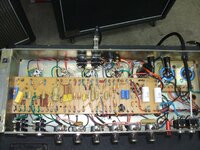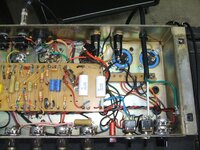
Marshall experts - can you check out this 2204

  • Thread starter Thread starter dstroud
  • Start date Start date
Hey Darren I had a look around and it does looks like the tech did lower the B+ to the power tubes as well from what I can see. Here are some stock pics of a 1987 2203 like yours that you can compare things to. You are just going to have to get a multimeter and see where the B+ voltages are.

https://www.kentonelectrix.com/1987-marshall-jcm-800-2203

Here are the stock pics.
View attachment 452956
View attachment 452957
View attachment 452958
got it dude thanks soooo much for the info!!! I’ll be digging into it :)
 
Agree with what harddriver said.
There's no right or wrong answer to the voltage thing.
If you want bright, harder and stiffer, higher is better. That's why some of those early 80's 2203's will rip yer face off ( in a good way! )
If ya want a chewy, greasy feel with a little more break-up, lower is the way to go. This is kinda what Friedman does with the BE100 preamp, although his power tube plate voltage is still high 400's.
If ya already have a Marshall style amp that does the bright and tight thing, then this new one is a nice complement to that.
Also keep in mind that lower plate voltage on the power tubes will greatly enhance the longevity of current production tubes, so there's that.
 
Here are some actual Marshall issued Voltage charts I have in my shop and in books for 50 watt Marshall amps in the 1977-1980 MKII JMP time frame and you can see they are calling for B+ of 390-395 so around 400 DCV B+ for a MKII 50 watt 2204.

https://www.marshallforum.com/threa....104885/?utm_source=google&utm_medium=organic
1783919873081.png
 
Hey Darren I had a look around and it does looks like the tech did lower the B+ to the power tubes as well from what I can see. Here are some stock pics of a 1987 2203 like yours that you can compare things to. You are just going to have to get a multimeter and see where the B+ voltages are. It looks like in 1987 Marshall only used two B+ rail dropping resistors and on that 1983 Schematic they used three 10K dropping resistors on the B+ rail and that's what my 1984 2204 had with the stock board from what I can remember and most schematics for 1977-1980 2204's show three 10K resistors being used.

So on your amp the tech used a 12K 2% tolerance( hence the 5 band color code) for the first dropping resistor and then added two more 10K dropping resistors on the V1A and V1B filter cap nodes so three dropping resistors same as they used in 1977-1980 2204's except for the first that is a 12K probably to tweak the voltages lower to the JMP values. While your preamp B+ rail has JMP values I still think your main power tube B+ may be in the 460-470 range you'll just have to see what it reads when you check the bias of the amp.

https://www.kentonelectrix.com/1987-marshall-jcm-800-2203

Here are the stock pics.
View attachment 452956
View attachment 452957
View attachment 452958
hey man so finally had a sec to crack the amp open - I was at 468v on the power tube B+. I was able to play the amp for several hours over the weekend - feels solid and sounds great, no wierdness lol I’ll prolly secure that long cable with proper clips and call it a day - thanks again so much for the info!!!
 
hey man so finally had a sec to crack the amp open - I was at 468v on the power tube B+. I was able to play the amp for several hours over the weekend - feels solid and sounds great, no wierdness lol I’ll prolly secure that long cable with proper clips and call it a day - thanks again so much for the info!!!


465-ish vdc is where my Friedman JMP 2203 sits, thats what you want. Enjoy.
 
hey man so finally had a sec to crack the amp open - I was at 468v on the power tube B+. I was able to play the amp for several hours over the weekend - feels solid and sounds great, no wierdness lol I’ll prolly secure that long cable with proper clips and call it a day - thanks again so much for the info!!!
Yep that's what I would do. Look like the B+ to the power tubes is totally stock voltage for a 1987 JCM800 since you are getting 468DCV that's right in line with my 1984 JCM800 2204 with 466DCV. So the tech before you owning the amp only lowered the phase inverter and the preamp B+ voltages more towards JMP values. So now you know exactly what's going on with your amp mod wise.:yes:

I bet it sounds pretty darn good, my 1979 2203 was a firebreather back in it's heyday totally stock. Enjoy the amp Darren!:2thumbsup:
 
I don't think Marshall used Philips head screws on the transformers (and no bracket). Unless they switched to this for these '80s amps? My first thought would be transformer swapped.
 
I don't think Marshall used Philips head screws on the transformers (and no bracket). Unless they switched to this for these '80s amps? My first thought would be transformer swapped.
maybe, But they look really old and say Drake so not sure
 
I don't think Marshall used Philips head screws on the transformers (and no bracket). Unless they switched to this for these '80s amps? My first thought would be transformer swapped.
maybe, But they look really old and say Drake so not sure
Both the Drake Power and Output transformers in my 1984 2204 have the very same galvanized Philips buttonhead screws to mount to the chassis. The choke still has a flathead brass machine screws. All the Drake transformer numbers on Darren's 87 2204 check out to be original and the aged patina is correct on the bellhousings to be original to that amp.:2thumbsup:
 
Both the Drake Power and Output transformers in my 1984 2204 have the very same galvanized Philips buttonhead screws to mount to the chassis. The choke still has a flathead brass machine screws. All the Drake transformer numbers on Darren's 87 2204 check out to be original and the aged patina is correct on the bellhousings to be original to that amp.:2thumbsup:

Fair enough. However RE: bell housings... when people swap iron, it's not hard to swap the bells. They just metal covers. Not saying this is the case for this specific amp. Just something to watch out for. You can't just go by a sticker on the end bell. That's why I always look at the totality of data: end bells, patina, laminations, dimensions, screws, brackets, wiring, soldering, etc.

I've seen many amps with swapped iron where it was clearly a cover up.
 
Fair enough. However RE: bell housings... when people swap iron, it's not hard to swap the bells. They just metal covers. Not saying this is the case for this specific amp. Just something to watch out for. You can't just go by a sticker on the end bell. That's why I always look at the totality of data: end bells, patina, laminations, dimensions, screws, brackets, wiring, soldering, etc.

I've seen many amps with swapped iron where it was clearly a cover up.
Easer to tell on the vintage Marshalls that used varnish on the solder joints; if those were disturbed at the power/ohm selector then you know the transformer's been messed with.
 
Agree with what harddriver said.
There's no right or wrong answer to the voltage thing.
If you want bright, harder and stiffer, higher is better. That's why some of those early 80's 2203's will rip yer face off ( in a good way! )
If ya want a chewy, greasy feel with a little more break-up, lower is the way to go. This is kinda what Friedman does with the BE100 preamp, although his power tube plate voltage is still high 400's.
If ya already have a Marshall style amp that does the bright and tight thing, then this new one is a nice complement to that.
Also keep in mind that lower plate voltage on the power tubes will greatly enhance the longevity of current production tubes, so there's that.
Yep!
In my experience, the 82/83 2203/4s can hit around 500v......beasts!
 
Easer to tell on the vintage Marshalls that used varnish on the solder joints; if those were disturbed at the power/ohm selector then you know the transformer's been messed with.
I'm pretty sure my 84 2204 didn't have any of that red machinist dye they used into the mid 70's. I bought that amp off of the original owner and I can't remember if my 79 2203 had the dye before Splawn rebuilt it. Come to think of it my 72 SL didn't have it either on any of the solder joints that were never ever touched since it was built as I know all the turrets I've soldered in that amp so there should be some remnants of the red dye elsewhere in the amp and there is none that I can see.
 

Attachments

  • DSCF3199.JPG
    DSCF3199.JPG
    968.4 KB · Views: 59
  • DSCF3200.JPG
    DSCF3200.JPG
    972.5 KB · Views: 56
Last edited:
I'm pretty sure my 84 2204 didn't have any of that red machinist dye they used into the mid 70's. I bought that amp off of the original owner and I can't remember if my 79 2203 had the dye before Splawn rebuilt it. Come to think of it my 72 SL didn't have it either on any of the solder joints that were never ever touched since it was built as I know all the turrets I've soldered in that amp so there should be some remnants of the red dye elsewhere in the amp and there is none that I can see.

Like everything else Marshall did, the use of dye was incredibly inconsistent. Sometimes they even used it on some connections but not all. And a lot of people try to fake the dye as well...
 
Like everything else Marshall did, the use of dye was incredibly inconsistent. Sometimes they even used it on some connections but not all. And a lot of people try to fake the dye as well...
^^^^^^^^^^^^^^^^^^^^^^^^^^^^^^^^^^^^^^^^^^^^^^^^^^
The one thing Marshall was consistent at was being consistently inconsistent..........................:LOL::LOL::LOL::LOL::LOL:
 
I'm pretty sure my 84 2204 didn't have any of that red machinist dye they used into the mid 70's. I bought that amp off of the original owner and I can't remember if my 79 2203 had the dye before Splawn rebuilt it. Come to think of it my 72 SL didn't have it either on any of the solder joints that were never ever touched since it was built as I know all the turrets I've soldered in that amp so there should be some remnants of the red dye elsewhere in the amp and there is none that I can see.
My 72 SL does. My old 72 50 did not. But, you can usually tell a factory solder joint vs one that's been messed with years later. Even without the dye, I think one could tell if a transformer has been out. Then, when you add in the cloth covered secondaries in the OT/PTs from the early 70s SL models that's another identifier for those years. The earlier C1998 OTs had the thicker plastic on the ends of the wires. Those two things aren't cloned by any modern transformers that I know of.
 
Then, when you add in the cloth covered secondaries in the OT/PTs from the early 70s SL models that's another identifier for those years. The earlier C1998 OTs had the thicker plastic on the ends of the wires. Those two things aren't cloned by any modern transformers that I know of.

Yeah, the Dagnall C1998 OT has cloth (glass reinforced) "self lead" secondaries. Drake transformers have standard plastic/PVC jackets.
 
Yep!
In my experience, the 82/83 2203/4s can hit around 500v......beasts!
Best 2203 I've ever heard was an '83.
Plate voltage was 495v.
It belonged to the teenage son of a friend of mine, and they asked me to re-tube it and bias it up .
The thing looked like total dog shit cosmetically. It had been dropped hard at least once, cause the tyranny brackets were bent to shit, and the bottom of the headshell was held together with door hinges! The logo was missing, and the front face where the logo would go was recovered with a piece of fabric from grammy's living room couch.
It had 3 power tubes in it when I got it, with the base of the 4th tube and a bit of broken glass still in the 4th socket.
So I retube it, bias it up, and son of a bitch, doesn't it sound fukking incredible.
One of the best sounding amps I've ever heard.
It punched hard, and was bright as hell, but if you swept the gain pot between 6 and 8 o'clock, you could find the sweet spot where the amount of bright cap in the tone was just right, and it was freaking amazeballs!
Total rip yer face off rock machine.
 

Similar threads

Back
Top