Half- vs Full-Stack

  • Thread starter Thread starter Simon Dorn
  • Start date Start date
I’ve only ran two cabs at a handful of gigs over the years, thoroughly enjoyed it each time. I get a fuller sound, with lower stage volume. I prefer the two cabs side by side, but a full stack is great as well.

I’ve mainly played rowdy venues as a local/regional weekend warrior. I had a few groups that were on a more serious path, but most of my playing out has been for fun.


A half stack has been my standard, occasionally I’ll run a combo or small cab, when necessary. It’s always fun when I have the time & space to break out the big guns.
 
I never did this for fun.
I was born to play.
If I don’t make music I waste away.

But having said that - when I started playing out, it soon became apparent that wrestling a guitar was a good way to get girls attention, and it was easy to walk all over the sleazy, smooth-talking cool guys, and steal the girl from right under their nose, after they’d vainly spent all night grinding them down.
Having 2 full stacks gave you a solid backdrop, which would frame my tender young body nicely. All about presentation. I’m what’s going on, not the poster on the wall behind some weedy ‘starter’ half-stack.

I grew out of the shagging novelty fairly quickly. There’s only so much Penicillin you can take, before your knob drops off.
Added to which, once I bought an Intellifex and ran two stacks in stereo - I would turn on that 8-voice multitap detune, and literally come in my pants.

Next stage in my career came with 5Kw of front monitors, and 2Kw of side-fills on my right. I could no longer hear the stacks. Any thoughts of sex soon vanished as the sheer wave pressure, combined with hallucegenic drugs - sparked me into incontinence nightly, and after a gig, you’re generally just looking for a sink to empty your piss-filled boots into.
 
Last edited:
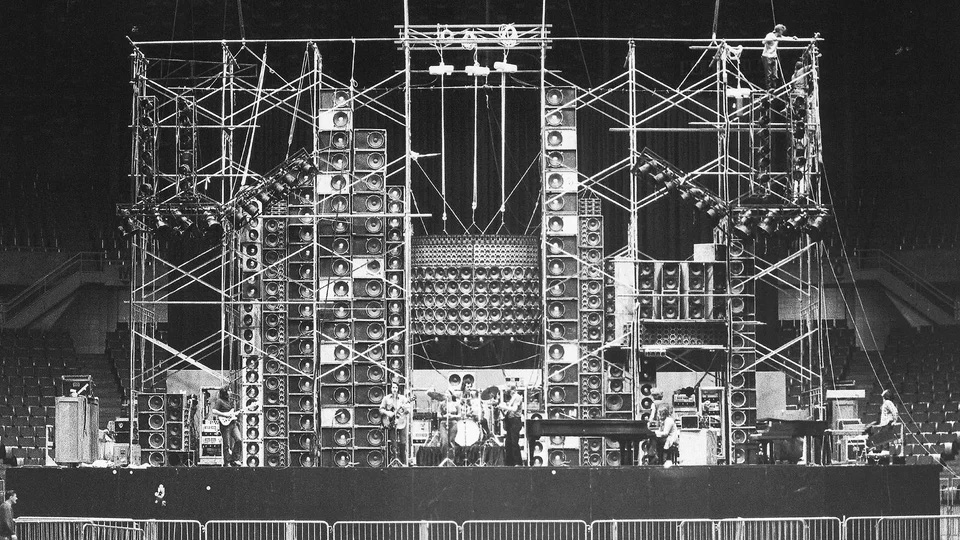
No thread about amp stacks is complete without a picture of this behemoth.

View attachment 454225


18-2-challenge-accepted-meme-png.png


The Grateful Dead: A Continual Development Of Concert Sound (Circa 1983) -  ProSoundWeb
 
I only use 2 4x12 cabs with my 1959HW because each speaker is rated at 25W, and I play it loud because that's what it's designed to do. These are the speakers it's supposed to use. I have different settings for my Fender Strat, my Gibson LP with DiMarzio Super Distortion in the bridge and Super 2 in the neck; my Ibanez PS10 with Duncan '59 in the neck and Custom 5 in the bridge, or my Chibanez with a set of DiMarzio D Activator-X

For Marshalls, I like the power amp to be a big part of the sound. I have a straight 4x12 cab capable of handling 240W for my other Marshalls and Bogner Helios Eclipse.

I use a pair of Engl E212VHB Pro cabs with my Engl Artist Edition E651.

I use a pair of Mesa 2x12 compact cabs with my JP-2C or my Diezel VHX.
 
Generally I will dial full gain, and work with the guitar on 7 or 8 max.
I set any master until I feel the negative feedback restricts response, then back off slightly.
I’m British, so treble and presence are set very low. This restricts gain, so invariably the amp will need a little push from a clean mid-boost like a Koko.
This approach helps me quickly get to the amp’s sweet spot.

Simpler approach for the 1959. But presence can be higher here. I bring levels up until it cooks
 
Stereo? I’ve been through it, and come out the other side. Now I only want a natural image.
Dry guitar equally from both cabs, with a short mono spring reverb panned slightly to thicken.
Then normal delay (340ms) toward the left, and a long, quieter (825ms) delay to the right. Never hard-panned.
Then 2.5 second hall reverb wide, but reversed in pan from the delays. Left delay will reverb on the right etc.
1st delay feeds the 2nd, and both feed the reverb too.
Reverb’s input has all the bottom-end taken off it, and treble is boosted to resemble a bright plate.
My stock lead go to.

I dislike stereo chorus and stereo vibe etc and don’t use any modulation and detune fx at all. Ducking delay is for faggots.
I am a purist for dry analogue signal, so everything is mixer fed and returned.
My aim is to get a natural guitar inhabiting its own little world, and on recordings, this entire image will be narrowed and positioned precisely where I want it in a mix.
Like Holdsworth, I just slot my go to into everything now with just minor tweaks. Took 50 years to get here musically, but the fx-side was finalised 25 years ago.
 
Last edited:
I played bars and clubs and had my own big, badass PA rig. I always used at least one 810 and my guitar player almost always used a half stack unless we were outdoors. And everything was always mic’ed. It always sounded bad ass.
 
Crazy how most of those "live performance gig videos" on TGP are in some dudes backyard with the bouncy house conveniently just out of the shot :hys:

Jesus christ man, why don't they just say they wanted to jam outside for their family for the 4th of july or whatever the occasion was? It's so obnoxious, because it's not hard to find video if you actually have a band that plays actual gigs.

But then when the evidence of the "gig" turns up, it coincidentally is in their backyard. Ya don't say.

The squirrels in my backyard go nuts when I play my Boss Katana 1x12.
 
I fucking hate stereo . Too airy . Idk just never my thing
But do I enjoy how others use it . Very much so . It’s great . But it don’t feel right at all for me
It feels very unnatural to me - the guitar is a point source conceptually.

Things like automatic double tracking or stereo detune can sound really cool - no doubt. But I would say they sound inherently unnatural. Sort of like a sci-fi sound.
 
It feels very unnatural to me - the guitar is a point source conceptually.

Things like automatic double tracking or stereo detune can sound really cool - no doubt. But I would say they sound inherently unnatural. Sort of like a sci-fi sound.
My music and guitar systems have been through every kind of development you could imagine.
Sometimes bordering on the insane.
However, at some point 20 years ago, I made the distinct move back to single-source guitar - with ambient stereo effects. I wanted it as natural sounding as possible.
This move went right through my whole approach to my music as a whole, and I wanted everything to have realism and a quantifiable familiar identity for the listener. Zappa, The Who, and Allan Holdsworth were helpful to use as reference when setting up my gear. Quadrophenia is incredibly natural throughout. I wanted that. It draws you in and involves you.
I worked hard on my monitoring gear, simplified my guitar amp rigs, and learned much about production as a whole.
The upshot is that now, I feel my music isn’t firing in your face. Still incredibly powerful when wanted, but the mixes have depth and ambience, with everything having its own place and space - but breathing together.
The idea is that the listener gets gently drawn in by the laid back presentation. But once they are involved, it all opens up beautifully for them, with a myriad of detail that you won’t get from a casual listen.
Going to the woods every day, and just sitting there listening - this was really helpful to train my ears away from ‘synthetic’ approaches to sounds. You don’t get birds flying by with an 8-voice chorus effect and harmoniser shimmer on their melodious chirping. Yet it is full of life and dynamic just as it is. You just have to relax for a few minutes, and the sound of nature reveals itself once you are still and quiet.
I wanted my music to do that to people. True escapism, whilst giving them something real and easily identifiable - whilst still being hopefully unique.
 
Back
Top