
I
iff
Active member
I see what appears to be second order RC high pass filters in the gain stages of some Engl and Bogner schematics as well as in pedals like the VFE Standout/Dragon and they often use R and C values in the first filter that are a multiple of 10/100/1000 of the second filter.
However if I simulate these values, it doesn't result in much steeper of a cut (if it's steeper at all) than just using a single filter with the smaller R and C of the second filter. Using two filters in a row with those smaller values gives me the expected steeper cut.
I feel like I'm definitely missing something here since the first filter seems pointless. But what? Or am I doing my simulations wrong? I assume there's also more purpose to it in a tube preamp where the first, larger cap is generally the coupling cap for the gain stage.
Using the VFE Standout values - V(out1) is totally hidden behind V(out2) :
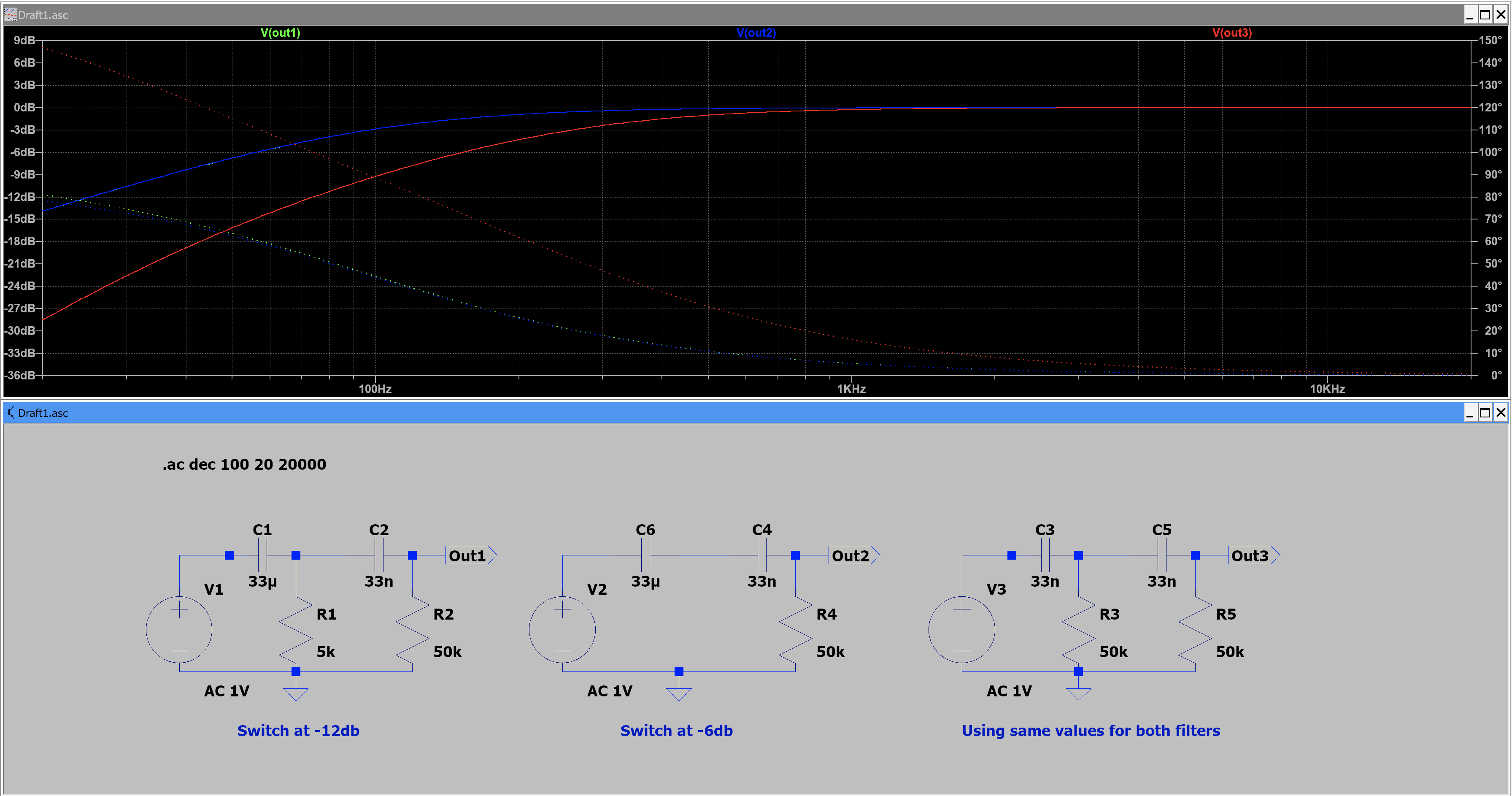
However if I simulate these values, it doesn't result in much steeper of a cut (if it's steeper at all) than just using a single filter with the smaller R and C of the second filter. Using two filters in a row with those smaller values gives me the expected steeper cut.
I feel like I'm definitely missing something here since the first filter seems pointless. But what? Or am I doing my simulations wrong? I assume there's also more purpose to it in a tube preamp where the first, larger cap is generally the coupling cap for the gain stage.
Using the VFE Standout values - V(out1) is totally hidden behind V(out2) :


