Talk me out of a Baritone

Tone is more solid with a longer scale but the audience can't tell or cares..
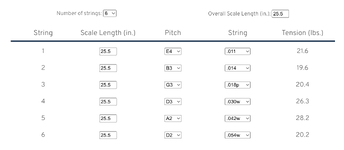
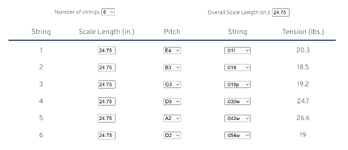
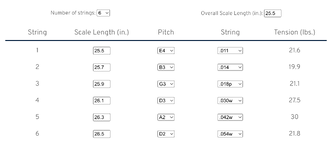
Tension is more with extra scale length. An extra inch is about half way to the next string gauge set.
An extra inch spread over the neck is actually noticeable to the fret hand and might take time to adjust..
 
Tone is more solid with a longer scale but the audience can't tell or cares..
Tension is more with extra scale length. An extra inch is about half way to the next string gauge set.
An extra inch spread over the neck is actually noticeable to the fret hand and might take time to adjust..

I find that the baritone vs. 7 or 8 string debate depends on the genre you play. I play alt-rock and modern country in one of the bands I am in. In that context, I started with a baritone to play the songs with the low C tunings with success. I thought I might do better with a 7-string, but it doesn't have the feel, snap, and twang of a Bari. So I have gone back to the Baritone for those tunes. It takes a little getting used to the longer scale length. But I think it is worth it...
 
I feel obligated to chime in here because I have always owned at least two "baritone" guitars (26.5" / 27" scale). I feel that the tension for standard drop d tuning on a baritone would be to much, even with light gauge strings. That said, on a 27" ESP, I favor D standard and Drop C (as low as I go these days) to be near perfect with Ernie Ball "Power Slinky" strings (11 - 48). I have tried many combinations and this one suits me best for hard rock and metal. When I used to play in Drop B, I would typically go 12 - 52 gauge. I hope that this helps.
 
Last edited:
I play drop D 99% of the time. I've used 52s, 54s, and 56s on both 24.75 and 25.5 inch scales and have found my 6th string to be too loose for my liking. When I play with Stringjoy's string tension calculator, it looks like something around 60 or 62 would "work" for me, but then I start wondering about something with a 26.5 or 27" scale.

Why wouldn't I get a baritone and play in drop D? Is that illegal?
Love my Ibanez Prestige 2027XL with a 27” scale.
I have it detuned a whole step, with 10-56s, and it plays great!
 
Played 5 baritones at CME today and didn't really like any of them - action was high on all of them and I'm obviously not gonna go in there and tune all of them up to drop D lol. So I was a little unimpressed. Two of them were Orangewoods (idk this brand and i've only seen em at CME and these were semi hollow P90 guitars that I am not really considering for this application). The other three were Reverends, which were nice, but I couldn't get past the action or the finishes (army green was ok, but had a big blemish, dark violin brown which was nice but goes against my 'fuck-brown' stance, and Periwinkle, which I really wanted to like, but didn't). I wound up falling in love with a Martin in the acoustic room, go figure.

So back to the drawing board and internet searches: I was sorta eyeing some Ibanezs but wasn't able to get my hands on any. The RGD61 Axion and the RGD3121 Prestige. Both are 26.5" which I think is where I want to start. I don't think I'm ready to commit the $$$ the Prestige would require for this potential project. Does anyone have any other suggestions?
 
ESP / LTD and Schecter both make reasonably affordable, high quality and great sounding baritones at 27" and 26.5" scales.
 
12e72334e86YYS53x3ovSuwLyRznzW0eeMcUiShv.wm-dh.png
 
I have an ESP 27" 7 string and it's glorious. I will add, make sure to get one with the reverse head stock for even more epic low string tension.
 
I’ve got the PRS Holcomb that’s 26.5”

It’s the 7 string version, which I tune to drop A. I find myself ignoring the low A & just playing it like a standard 6 half the time. The scale length makes some riffs & chord shapes difficult on the first 5 frets, but it doesn’t really interfere with my style and I love the way it feels up high.
 
I have an ESP 27" 7 string and it's glorious. I will add, make sure to get one with the reverse head stock for even more epic low string tension.

This is something I've never actually considered. Does that extra length post nut (lol) really do something for the tension on the bass strings?
 
This is something I've never actually considered. Does that extra length post nut (lol) really do something for the tension on the bass strings?
The way I see it there are two types of "tension". One is defined as the pull between the two end points- the tuning peg & the ball end (or clamp on a FR). Reverse headstock affects this.

The other I like to think of as "deflection", which will be the resistance to bending between two stopping points- which are the bridge and the nut. That said, in order to bend the string must stretch.

Now, if you have a locking nut then the stretch of the string stops at the nut under deflection so the headstock shape won't matter. If however you have a standard nut, the stretch if the string will take into account the entire ball to post length. So imo yes, this matters to tension.
 
Back
Top