Bay Area Thrash Mod V2

  • Thread starter Thread starter FourT6and2
  • Start date Start date
FourT6and2

FourT6and2

Well-known member
Here's a B.A.T mod I'm working on for someone who had their 2203 modded by someone else, but they weren't happy with how it turned out.

That previous mod was some sort of 5-stage attempt, but there were a number of mistakes, so I gutted it and started over. The bass and mid controls weren't wired correctly, some voltage issues, filtering problems, and the extra gain stages were haphazardly tacked onto the front of the amp without addressing the rest of the circuit. It just wasn't a fully integrated and coherent design.

V2 of my Bay Area Thrash mod has been greatly updated and improved—a modern evolution of Langner's original Marshall mod. Tighter, punchier, angrier, brighter, more grind and growl. All while retaining the fun, bouncy feel that makes this circuit so fun to play. It's a modern metal monster now.

The additional gain stages get their own independent filtering, preamp voltages are raised significantly for a tighter response, low-pass filters are greatly reduced to retain more high end, and I implemented a few other tricks I've worked out to make this version more aggressive and pissed off, while retaining that Marshall vibe we all love.

Clips to come!

Here's how the amp came to me:
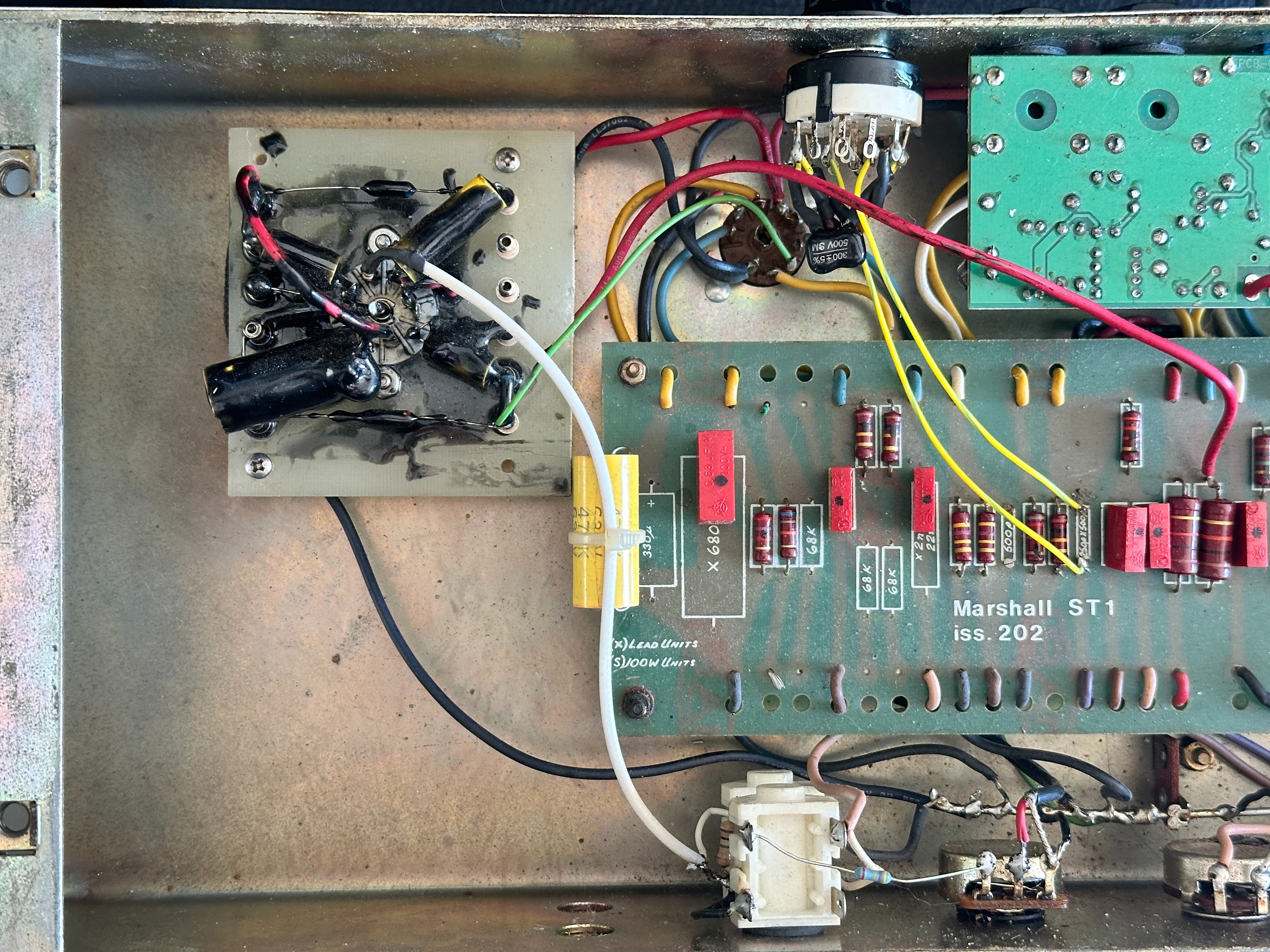
IMG_2557.jpg


IMG_2558.jpg


IMG_2559.jpg


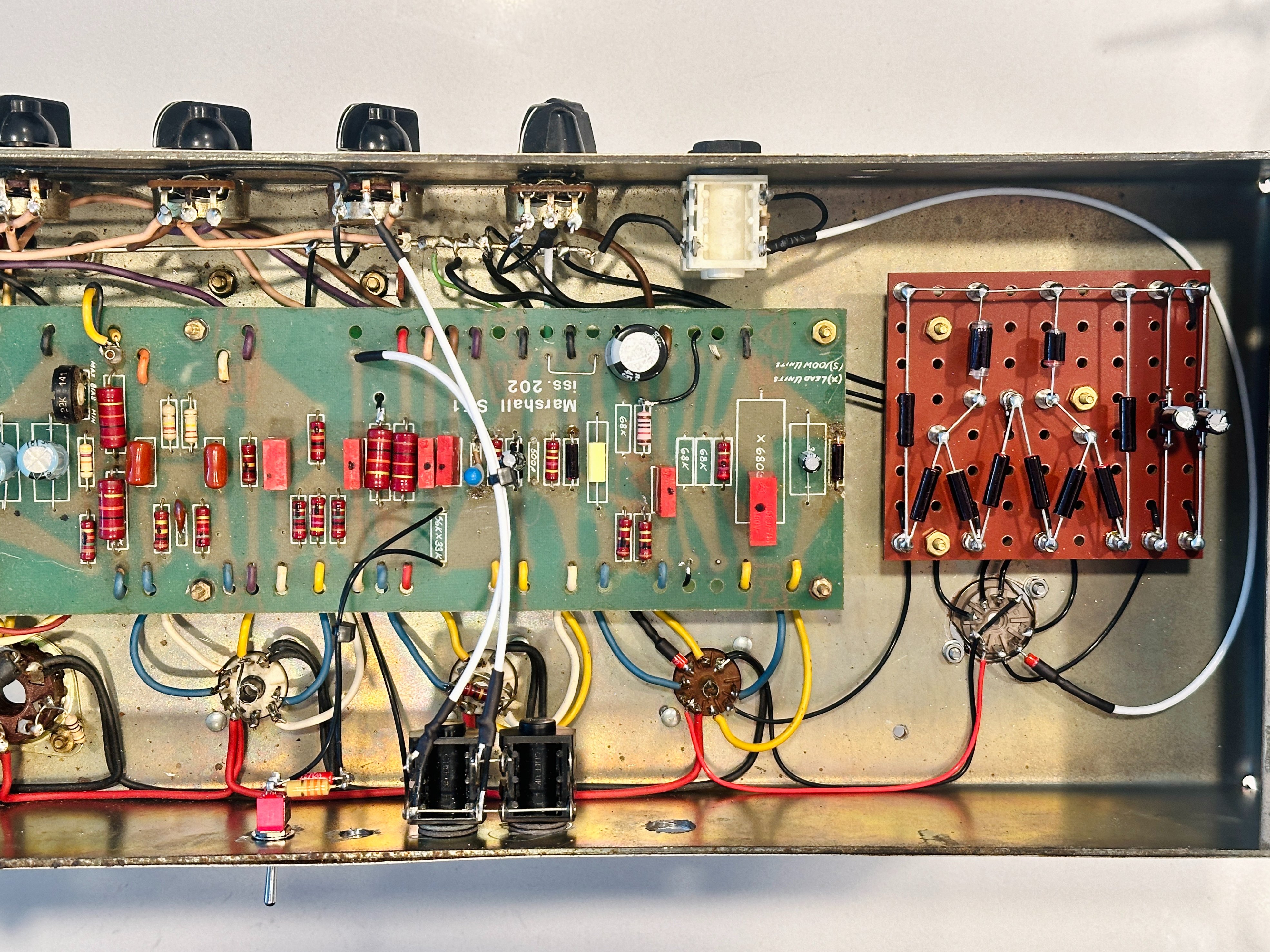
And after:

IMG_2582.jpg


Last edited:
Here's a B.A.T mod I'm working on for someone who had their 2203 modded by someone else, but they weren't happy with how it turned out.

That previous mod was some sort of 5-stage attempt, but there were a number of mistakes, so I gutted it and started over. The bass and mid controls weren't wired correctly, some voltage issues, filtering problems, and the extra gain stages were haphazardly tacked onto the front of the amp without addressing the rest of the circuit. It just wasn't a fully integrated and coherent design.

V2 of my Bay Area Thrash mod has been greatly updated and improved—a modern evolution of Langner's original Marshall mod. Tighter, punchier, angrier, brighter, more grind and growl. All while retaining the fun, bouncy feel that makes this circuit so fun to play. It's a modern metal monster now.

The additional gain stages get their own independent filtering, preamp voltages are raised significantly for a tighter response, low-pass filters are greatly reduced to retain more high end, and I implemented a few other tricks I've worked out to make this version more aggressive and pissed off, while retaining that Marshall vibe we all love.

Clips to come!

Here's how the amp came to me:
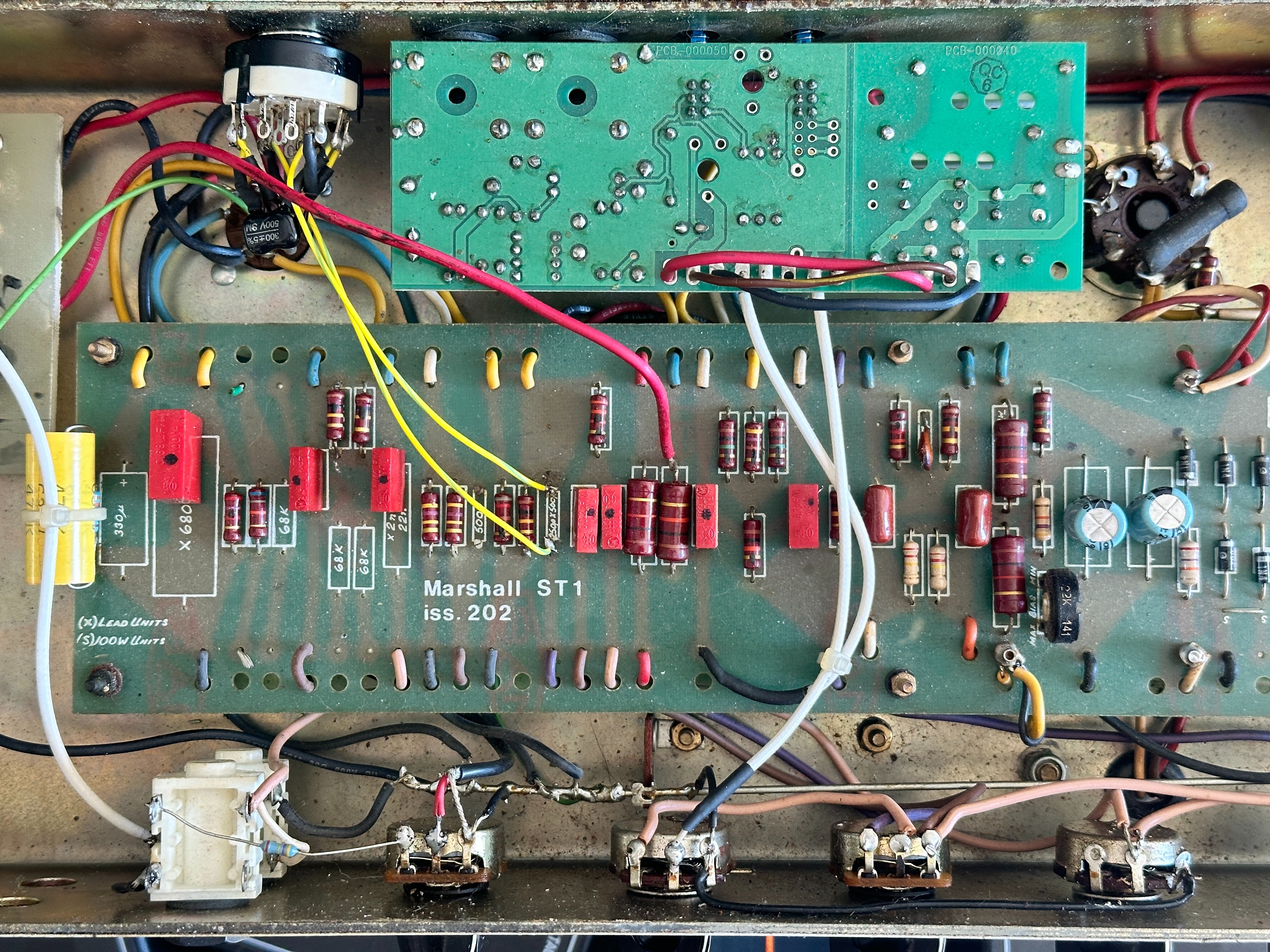
View attachment 457348

View attachment 457349

View attachment 457350


And after:

View attachment 457351
I hope i get to play one of your amps sometime. You have a good reputation
 
Here's a B.A.T mod I'm working on for someone who had their 2203 modded by someone else, but they weren't happy with how it turned out.

That previous mod was some sort of 5-stage attempt, but there were a number of mistakes, so I gutted it and started over. The bass and mid controls weren't wired correctly, some voltage issues, filtering problems, and the extra gain stages were haphazardly tacked onto the front of the amp without addressing the rest of the circuit. It just wasn't a fully integrated and coherent design.

V2 of my Bay Area Thrash mod has been greatly updated and improved—a modern evolution of Langner's original Marshall mod. Tighter, punchier, angrier, brighter, more grind and growl. All while retaining the fun, bouncy feel that makes this circuit so fun to play. It's a modern metal monster now.

The additional gain stages get their own independent filtering, preamp voltages are raised significantly for a tighter response, low-pass filters are greatly reduced to retain more high end, and I implemented a few other tricks I've worked out to make this version more aggressive and pissed off, while retaining that Marshall vibe we all love.

Clips to come!

Here's how the amp came to me:
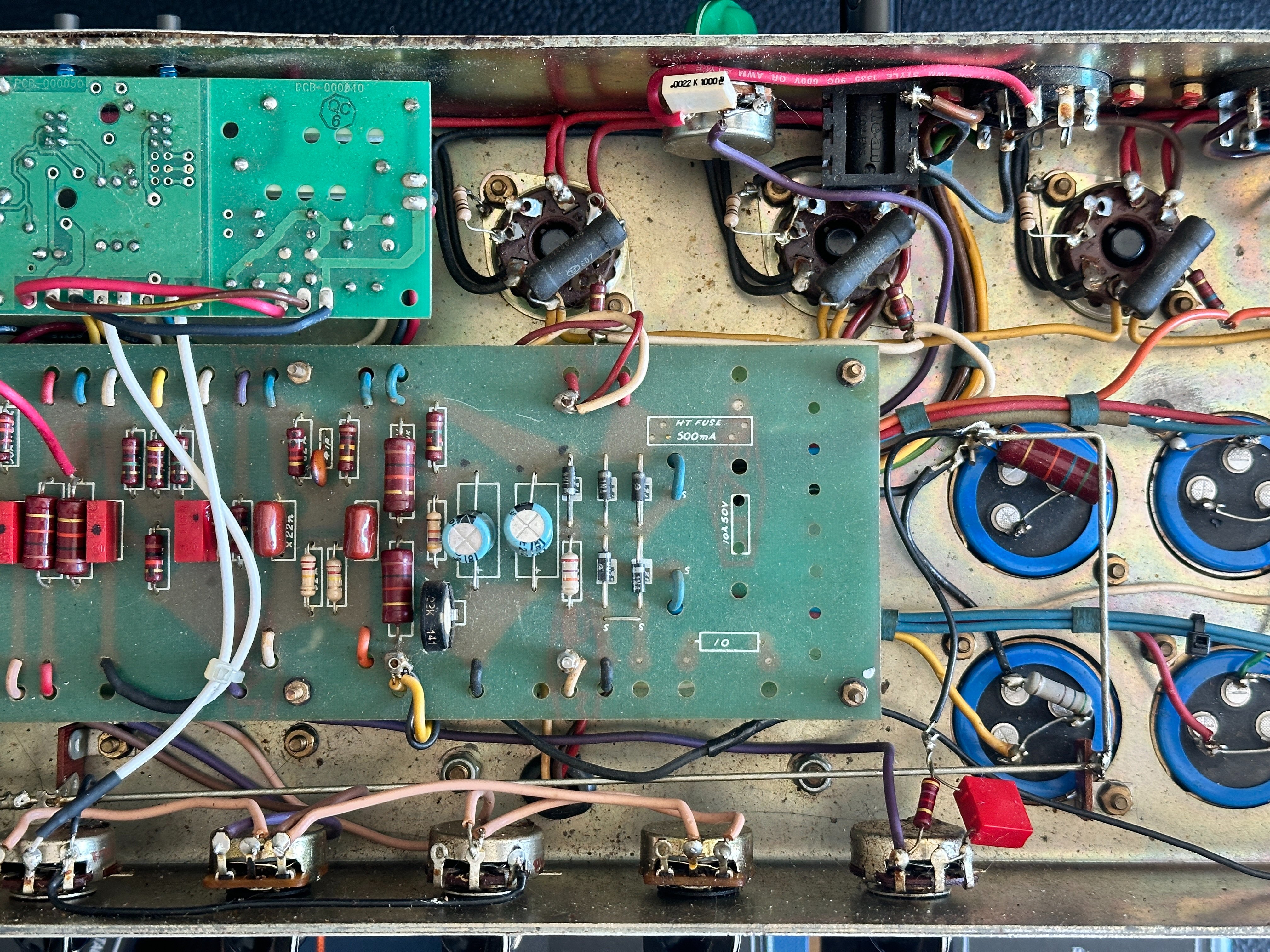
View attachment 457348

View attachment 457349

View attachment 457350


And after:

View attachment 457351
what sonic differences do the extra dc filtering make to the pre?
 
I have always wanted to try a BATM. 20 years ago I passed up the perfect canidate head. Late 70s JMP 2203. My wife was a stay at home mom for our kids and I barely made enough to cover the bills back then.
 
I have always wanted to try a BATM. 20 years ago I passed up the perfect canidate head. Late 70s JMP 2203. My wife was a stay at home mom for our kids and I barely made enough to cover the bills back then.

Yeah that would make a good donor
 
what sonic differences do the extra dc filtering make to the pre?

tl;dr
A stronger, healthier sounding amp; tighter, thumpier, faster low-end tracking; less noise; less ghosting; and keeps the amp from motorboating.


In more detail, filtering does a few things:

1. The preamp is DC powered. The rectifier in a guitar amp converts AC to pulsating DC. A byproduct of this is ripple and noise (120 Hz hum). The main reservoir filter caps charge on the voltage peaks and discharge to the rest of the circuit during the valleys. This smooths the AC ripple riding on the DC supply. So more filtering generally yields lower noise and a smoother DC supply to each gain stage in the preamp. Ghosting typically happens when a note creates harmonic dissonance with this 120 Hz ripple. Reduce the ripple, eliminate the ghosting.

2. Filter caps act as a local energy reserve. Heavy, loud, dynamic playing requires a lot of immediate power to keep the low end tracking fast and tight. When you dig into a heavy chuggy chuggy riff (especially in lower tunings) the power section draws a large current. The rectifier and power transformer can't typically keep up. So filter caps supply the missing power.

3. Filter caps help decouple each gain stage. The B+ line supplies high voltage to each gain stage through a series of dropping resistors. Without filter caps at each of these power supply nodes, the gain stages would share a common impedance path and common filtering. By decoupling each gain stage via dropping resistors and individual filter caps, the caps shunt any stray signal riding on the DC line to ground. Without this filtering, the amplified signal from one stage could modulate and feed back into another stage, causing low-freq. oscillation (motorboating).


In a vintage amp, designed for lower gain rock... this stuff isn't a huge issue. When you start adding more gain and more gain stages and you start playing heavier, faster music, a circuit designed to play classic rock starts to fall apart.

Todd Langner never added individual, decoupled filtering to the extra gain stages in his Marshall mods. At least not that I've seen. And neither do most techs who do mods. When most techs add gain stages, they install another tube and then just wire everything up in series with the existing gain stages. So you end up with FOUR gain stages all sharing common B+ supply node and one 50uF filter cap. This creates all sorts of problems. It's better to install additional filtering for each stage. Takes more time, more work, more effort. But if you're gonna do something, do it right.

This is also why attractive plug-and-play "mods" that you plug into a tube socket only get you so far...
 
Last edited:
Excited for clips to see what you’ve been conjuring up Mike!

What was said about filtering is valid and the truth. What you gain in isolation you do trade for somewhat reduced headroom as voltages drop.

Motorboating is caused by a lesser known more complex problem that added interstage filtering does resolve, but not for the reasons people think. I don’t add any additional filtering stages.
 
What was said about filtering is valid and the truth. What you gain in isolation you do trade for somewhat reduced headroom as voltages drop.
Which is why I raise the voltages for the entire preamp as well. By a lot. And the added gain stages' B+ isn't run in series with the existing ones, like what Langner typically did, so there isn't any voltage reduction anywhere.

I don’t add any additional filtering stages.
Right, Langner didn't add additional filtering either. The whole point here is I'm doing something different because I don't want that sound. Modern high-gain amps tend to have independent filtering for each stage, or a the very least, each 12AX7. This isn't a classic rock amp, it's not a hard rock amp, and it's not an '80s hair metal amp. It's a modern metal machine. Needs to be tight.
 
Last edited:
Which is why I raise the voltages for the entire preamp as well. By a lot. And the added gain stages' B+ isn't run in series with the existing ones, like what Langner typically did, so there isn't any voltage reduction anywhere.

You should see voltage some reduction at the power tubes right off of the PT - it can only supply so much current and the added stages will drop it there. Power tubes will be happier, the PT won’t really care for a few preamp stages, but it’s definitely measurable.

Right, Langner didn't add additional filtering either. The whole point here is I'm doing something different because I don't want that sound. Modern high-gain amps tend to have independent filtering for each stage, or a the very least, each 12AX7. This isn't a classic rock amp, it's not a hard rock amp, and it's not an '80s hair metal amp. It's a modern metal machine. Needs to be tight.

Excited to hear what different offers!

I do still filter each stage - you have to - there’s no way with a mix of solid state and tubes not to add additional beefed up filtering to fight the MHz garbage that can come about from doing so. Just what I’m doing is way different than what I think you’re doing which is a good thing - we all have our methods and ideas for noise reduction and tightness.
 
Man you weren’t kidding on the tightness. It definitely has more of a growl to it and is brighter. I actually think I like the Creamback clip more - it brings out more of the highs you voiced it for. IMO my greenbacks need some volume behind them to accentuate the highs - there’s a sweet spot that’s definitely not apartment friendly.

I wouldn’t say one version over the other is better - they both sound great.
 
Back
Top