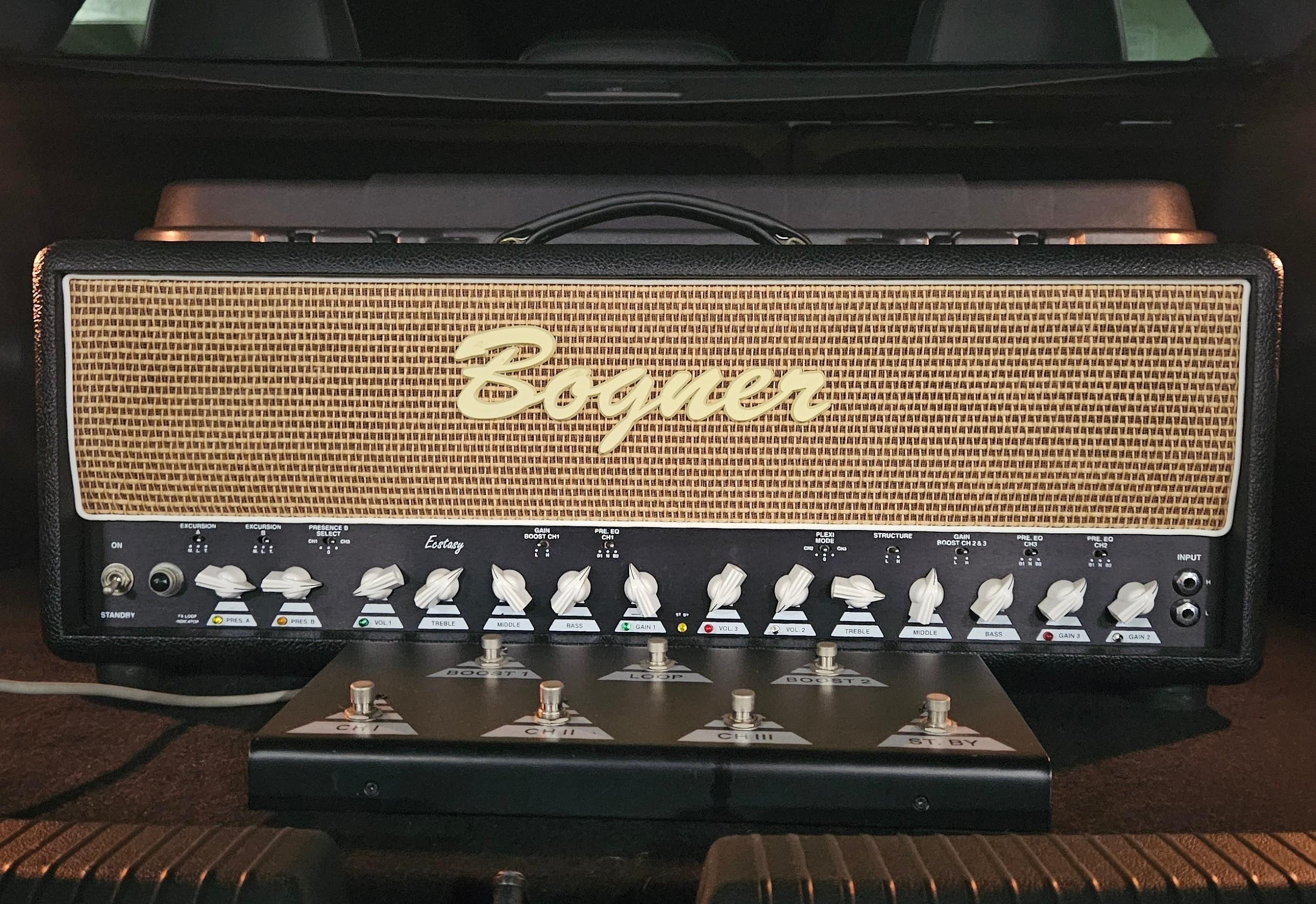
Might sound goofy but, whatever - in my head, my 'dream Marshall' has always been what i thought was the legendary '68 smallbox Accept 'allegedly' used to record the album Restless & Wild. The 101b's blue channel delivers that sound better than anything I've heard. And on top of that you have the wonderful red channel that's basically an extension of that blue channel, but different in a way. Then a beautiful clean channel to boot and toggelz to tweak things. Yes

Supposedly Wolf's tone was a Marshall Superlead cranked with an old Yellow/greenish MXR Distortion plus using the output level of the MXR to control the volume of the amp. I ran an old MXR Distortion plus with a 79 Marshall 2203 with a 12H-30 cab like Randy Rhoads for years and it was a great tone but I never did try the Wolf Marshall trick with the MXR and the EMG 81's..
You also have to remember Wolf was running EMG 81's as well, which I have never tried which is part of the puzzle. Those Accept albums had a great grindy tone with a distinct mid range to them, loved that tone!
This song is just killer on so many levels.. Sick tone, Great groove, Thumping bass line, Great solo, and suggestive lyrics that made my teenage brain take notice when I heard this back in the late 80's .... Metal at its finest . After all these years this album ( Balls to the Wall ) still holds up quite well !
Question: Did you run the amps really loud in the studio?
Wolf: It changed over the years. In the beginning we had regular non-master volume Marshalls, and those were fucking brutally loud. You couldn't be in the same building with them. And they never gave us the warm, fuzzy distortion we were looking for. So we ended up using those MXR Distortion Pluses.
Question: That's funny because my very next question was: the old Marshall plexi you used on the early albums (
Breaker,
Restless and Wild, Balls to the Wall) created a sound that was a lot more "heavy metal" than say the typical "hard rock" plexi sound of AC/DC or Jimmy Page. How did you achieve that more metal sound?
Wolf: Right. That again was born out of necessity. If you cranked the Marshall all the way to 10 or to 7 or 8, you could use the Distortion Plus'
Output control to regulate the Marshall's volume so that you could bring it down to a volume you could actually play with. In essence you have a master volume effect — the amp is still sweating, but you can control the volume. The
Distortion control was set not all the way up, but almost all the way up. You can still do it today. The only bad part is you get a lot of noise. We always had to turn down the volume immediately if there was a break. I say "we" — whoever the other guitarist was at the time would use the same set up. We always kind of did that as a team. That trained me real well, and I still do it to this day, but with the advent of hush units you don't need all that stuff.