Buffers before or after Overdrive Pedals?

Th
“buffer” is a misconception. Whichever pedal is activated becomes the buffer, which “loads” the pickups. my approach is the “always on” type of pedal.

Look at the input impedance of your amp (usually 1 meg-ohm)

Look at the input impedance of your first activated or… “buffered” pedal: usually 1 meg-ohm.

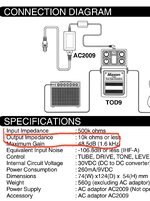
Consider exceptions like TS9 tube screamer type or boss DS-1 which are 500k ohms.

If you put a “always on pedal” that has 1-meg ohm input impedance IN FRONT of a TS9 pedal, your pickups won’t see the 500k input of the TS9, instead they will be loaded by the first activated always on pedal (or “buffer”) in front of it - which will be a closer feel/response/tone to your conventional 1-meg amp input.

So you have to decide what you want. Do you want to load your pickups with a TS9 type 500k input or match what your amp would feel like?

*everything downstream of the first activated pedal (or “buffer”) will have no effect on your pickups*

Yes it will affect tone and feel… but electronically, only the first activated pedal “sees” your pickups. Don’t confuse buffered bypass in all this, let’s just pretend they don’t exist
This makes a lot of sense thank you.

My od is an od808 and my buffer is 1meg ohm

Probably explains why the buffer before my od sounds brighter because the pickups are seeing 1 meg ohm rather than 500k?
 
This is probably not the most scientifically accurate example but I kinda think of it like this.

Imagine you are blowing into a straw while holding it between your index and thumb fingers. Your mouth (the guitar pickups) can blow at a certain pressure from 0 - 10 through the straw. Your fingers holding the straw pick up how much pressure they feel and pass the signal along for highs and low on a scale from 0 - 10. 0 being max lows, 10 max highs.

If you use a small straw that provides enough resistance to your lung capacity, your fingers holding the straw can pick up the full pressure range as it expands and contracts. If you use a lower resistance (impedance), large wrapping paper tube and blow into it with the same force your fingers may only see a range of pressures from 0 - 8 as you're not able to provide enough force to expand it fully with your lungs.

So matching the impedance initially to the guitar pickups passes that full 0 - 10 range along like the small straw from the get go, much like a game of telephone.

Lets say you have only one buffer and put it after your od. Because you had not placed a buffer before it, the top value the od sees going into it is capped at an 8, but because it has lots of cabling after it the max out of the amp winds up being a 6. - the treble is rolled off.

The buffer after the od would allow it to pass an 8 to the amp so it would still be brighter than without it (a 6), but not quite as bright as it could be (a 10) if you had also loaded the pickups with a proper buffer from the start.
Great info. Interesting my test showed this:

Buffer -> OD -> Amp = brighter

OD -> Buffer -> Amp = not quite as bright
 
This is probably not the most scientifically accurate example but I kinda think of it like this.

Imagine you are blowing into a straw while holding it between your index and thumb fingers. Your mouth (the guitar pickups) can blow at a certain pressure from 0 - 10 through the straw. Your fingers holding the straw pick up how much pressure they feel and pass the signal along for highs and low on a scale from 0 - 10. 0 being max lows, 10 max highs.

If you use a small straw that provides enough resistance to your lung capacity, your fingers holding the straw can pick up the full pressure range as it expands and contracts. If you use a lower resistance (impedance), large wrapping paper tube and blow into it with the same force your fingers may only see a range of pressures from 0 - 8 as you're not able to provide enough force to expand it fully with your lungs.

So matching the impedance initially to the guitar pickups passes that full 0 - 10 range along like the small straw from the get go, much like a game of telephone.

Lets say you have only one buffer and put it after your od. Because you had not placed a buffer before it, the top value the od sees going into it is capped at an 8, but because it has lots of cabling after it the max out of the amp winds up being a 6. - the treble is rolled off.

The buffer after the od would allow it to pass an 8 to the amp so it would still be brighter than without it (a 6), but not quite as bright as it could be (a 10) if you had also loaded the pickups with a proper buffer from the start.
Awesome analogy! Another good one that REALLY helped me understand after many years of confusion (I work with electricity for a living but not this kind). When I say “pickup loading” means that pickups are connected directly to it (first device in chain that is either activated or always activated in a buffer context)

1 meg-ohm example pickup loading: You have a water bottle. You poke a small hole in the cap and squeeze the water bottle. The water will have a steady stream even if you adjust or change how hard you squeeze it - this is higher impedance, proper loading of pickups.

5,000 - 50,000 ohm example pickup loading example: You have a water bottle only this time you remove the cap. Hold that thing upside down and without squeezing the water is going to glug glug and have in inconsistent stream kind of like when you had kidney stones because you were drinking 4 rockstars and refills a day - this is too low impedance but gives desirable characteristics when you want that sludgy filthy fuzz tone.

Vintage fuzz tones will have that low impedance but newer fuzz pedals don’t because: Ideally, audio devices input impedance will be at least 10 times higher than the output device feeding (or before) it.

I believe pedals usually have around 10k ohm output impedance so 100k or higher is needed to meet the criteria. This is why companies will often say about their fuzz pedals: “plays nice with other pedals” or “works after buffers”. This mindset is outdated marketing claims similar to saying that a pedal having “true bypass” is a standout feature
 
Great info. Interesting my test showed this:

Buffer -> OD -> Amp = brighter

OD -> Buffer -> Amp = not quite as bright
That means that the roll off from the pickups' mismatched load was greater than whatever came after the od, so you found the right spot!

Why do some people swear by putting it at the end then?
Imagine you had the worlds worst cable after the od, to the amp, and only 1 buffer to use. This could a good time to put the buffer last.

Lets say after the od, the 'straw' (crappy cable) it sees is double the diameter what it should be.. so if the od sends an 8 in pressure the most the last cable will send is a 4. If you put the buffer in front of the od so it now received and sent a 10, the cable could only send a 5 max (assuming double the diameter meant it needed double the pressure) - a small improvement but not the best

If you put the buffer at the end after the od, it would 'correct' the cable diameter and make it able to send a normal range again without needing more pressure. It could then send the 8 the od sees and give you the most treble bang for the buck you could get with that setup.

So yeah, good to mess around a bit sometimes to find what out you like (y)
 
That means that the roll off from the pickups' mismatched load was greater than whatever came after the od, so you found the right spot!

Why do some people swear by putting it at the end then?
Imagine you had the worlds worst cable after the od, to the amp, and only 1 buffer to use. This could a good time to put the buffer last.

Lets say after the od, the 'straw' (crappy cable) it sees is double the diameter what it should be.. so if the od sends an 8 in pressure the most the last cable will send is a 4. If you put the buffer in front of the od so it now received and sent a 10, the cable could only send a 5 max (assuming double the diameter meant it needed double the pressure) - a small improvement but not the best

If you put the buffer at the end after the od, it would 'correct' the cable diameter and make it able to send a normal range again without needing more pressure. It could then send the 8 the od sees and give you the most treble bang for the buck you could get with that setup.

So yeah, good to mess around a bit sometimes to find what out you like (y)
Remember, the OD itself is a buffer (when activated, if true bypassing), it’s just a different buffer that is coupled to the other circuitry of the OD.

Professional pedal boards will often have an input buffer at the very beginning that loads your pickups, and an output buffer at the very end of the pedal chain.

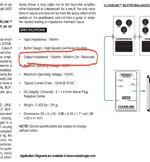
This way the guitarist will always have the same feel no matter what pedal is downstream of the input buffer. The output buffer is to send the signal to the amp no matter what. Not the best connection? 100 ft cable run? No problem. Look at the output impedance of the Mesa Send. 150 ohms. Look at the output impedance of a boss pedal: 10,000 ohms.

Having a separate output buffer or line driver is overkill for most circumstances. But most guitarist just don’t know why they like what they like which is fine. If it sounds good, it’s good. It’s just that there are simple technical explanations for a lot of these things that are objective. In my experience, I like the typical 10k ohm output to an amp more than a 150 ohm output but the difference is minimal.
 

Attachments

  • IMG_2309.jpeg
    IMG_2309.jpeg
    329.6 KB · Views: 0
  • IMG_2310.jpeg
    IMG_2310.jpeg
    399 KB · Views: 0
Back
Top