Mesa 4x12: Standard (oversized) vs Traditional

  • Thread starter Thread starter FourT6and2
  • Start date Start date
@FourT6and2,
I'm pretty sure the difference I'm talking about is feel, and how the speaker responds to different wiring layouts. Both of my 4x12 diagrams have the same final ohm reading, so electrically they both get to about 14 ohms for a 412 with 16 ohm speakers. But there is a difference in the speaker response that can be heard. Or do you think Roy, George, Dave & I can't hear?
 
Up until recently, all my 4x12s have been Bogner. I've really never used anything else. But now I have this Mesa and I have a Hiwatt on the way. I knew Marshall and some others did it differently, but whenever I wired or re-wired a 4x12, I just did what I saw in my Bogner cabs because it uses less wire, it's simpler, and it's faster.

I mean, can it get easier than this? Two parallel pairs of speakers, each wired in series. No crowded terminals anywhere. No mass of wires to try to trace and follow.

cab-jpg.426443

I've only rewired two 412 cabs ever, and this is how I did both of them solely for the sake of simplicity. My reference was the series-parallel scheme from the Stew-Mac website.
 
Yes the one on the left is the same as the one in the attached link. In my opinion that wiring yields the best tone after trying both in the same cab. There are only two ways to wire a 4x12. Either you Parallel the pairs together or you Series the pairs together. As FourT6and2 mentioned any other differences are just moving around where the wires make contact which sometimes even unessesarily adds more wire. As an electrician that part seems silly to me, but I'm not an audio expert. If you change the placement of where you make contact I dont see how that effects sound in any way other than possibly adding or removing a very tiny amount of resistance.

Exactly. You get it.
 
@FourT6and2,
I'm pretty sure the difference I'm talking about is feel, and how the speaker responds to different wiring layouts. Both of my 4x12 diagrams have the same final ohm reading, so electrically they both get to about 14 ohms for a 412 with 16 ohm speakers. But there is a difference in the speaker response that can be heard. Or do you think Roy, George, Dave & I can't hear?

I think we're talking past one another. Simply moving a wire off the jack and soldering it to the speaker tab instead, hasn't changed how the speakers are connected—it simply changes where the speakers are connected. And that doesn't change anything at all.

Maybe you're misremembering what took place during your tests many years ago? Maybe the actual wiring was changed over from series/parallel to parallel/series or vice versa? But the number of wires on the jack has no bearing on it.

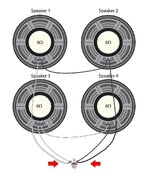
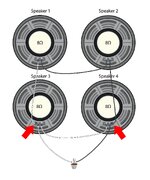
These two are exactly the same. They are both two pairs of series speakers, in parallel at the jack.

new cab.jpg


cab-1.jpg
 
Last edited:
No, I'm not "mis-remembering" the wiring scheme, nor am I confused. Why don't you try both wiring schemes yourself, and choose the one you like?
 
If I had to guess what could make the 2 ways sound different is the fact that one way puts all the power through 2 small wires vs 4. And longer runs of wire? It'd be interesting to try both ways and scan the wires with IR thermal to see if the heat signature changes. We have electricians at work do IR scanning of our electronics and you'd be shocked to see the temp difference just a loose connection can make on high voltage electronics.
 
If I had to guess what could make the 2 ways sound different is the fact that one way puts all the power through 2 small wires vs 4. And longer runs of wire? It'd be interesting to try both ways and scan the wires with IR thermal to see if the heat signature changes. We have electricians at work do IR scanning of our electronics and you'd be shocked to see the temp difference just a loose connection can make on high voltage electronics.

A few inches of wire isn't going matter. But we're dealing with moving the same two wires from point A to point B. So the total length of wire in the system hasn't changed either way. It's just disconnecting a wire at the jack and moving it to the speaker terminal, which is STILL connected to the jack at the same exact spot.
 
I think we're talking past one another. Simply moving a wire off the jack and soldering it to the speaker tab instead, hasn't changed how the speakers are connected—it simply changes where the speakers are connected. And that doesn't change anything at all.

Maybe you're misremembering what took place during your tests many years ago? Maybe the actual wiring was changed over from series/parallel to parallel/series or vice versa? But the number of wires on the jack has no bearing on it.

These two are exactly the same. They are both two pairs of series speakers, in parallel at the jack.

View attachment 426980

View attachment 426983
I don’t understand how you can’t see how those are different.
 
I don’t understand how you can’t see how those are different.
The two circuits attached are the same. Is that what you are referencing?
 

Attachments

  • IMG_0035.jpeg
    IMG_0035.jpeg
    228.1 KB · Views: 43
  • IMG_0034.jpeg
    IMG_0034.jpeg
    217.7 KB · Views: 34
Last edited:
No, I'm not "mis-remembering" the wiring scheme, nor am I confused. Why don't you try both wiring schemes yourself, and choose the one you like?
Are the two diagrams I attached the circuits you used when you did your test? Just trying to see if we can clear this up.
 

Attachments

  • IMG_0035.jpeg
    IMG_0035.jpeg
    228.1 KB · Views: 38
  • IMG_0034.jpeg
    IMG_0034.jpeg
    217.7 KB · Views: 48
Last edited:
Explain it to me.

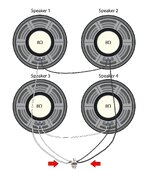
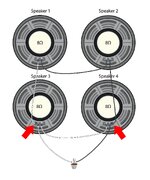
Are these two different? Move the wires off the jack and splice them into the other ones that are in parallel.

a-jpg.426881


b-jpg.426885
These pictures are not what you posted in the other post. In the other post those pictures are different.
 
These pictures are not what you posted in the other post. In the other post those pictures are different.

What in the name of EVH's ghost is happening lol... y'all are trolling or what? Go read post 128.
 
Last edited:
Are the two diagrams I attached the circuits you used when you did your test? Just trying to see if we can clear this up.

That's what I'm trying to get at.

Some people might rewire their cab, but end up not a changing anything. Then they think they hear a difference.

And then Scumback said, "4 wires at the jack is Series/Parallel. Two wires at the jack are parallel/series." But that's not always true, which is what started this whole thing—case in point, those diagrams. Both are the same.
 
OMG thank you! Why is this so hard for other people to understand. You are a saint :)

I see what you are saying also. The change in that diagram is basically changing soldering from one end of the wire to the other. That wont change anything.

One of the only diagrams posted in this thread that looks different to me is this one:

Naming conventions are confusing me the most here, this diagram is the same as the ‘parallel series’ in the below diagram posted by FourT6and2 on page 3

View attachment 426933


Although, the funny thing is my cabs dont match either, lol. It is closest to the right though. My cabs would connect the 2 bottom speakers to the jack, and then the top speakers are paralleled to those speakers, based on that right diagram.
 
Is one way more resilient load wise than the other? Like @hardwire was saying?
 
Is one way more resilient load wise than the other? Like @hardwire was saying?
This might help:

There are only two ways to wire a 4x12 cabinet to yield an 8ohm or a 16ohm result, which in general is the target we go for with guitar cabs. . One way is to connect each pair in series OR connect each pair in parallel. Then "At the jack" you connect the two pairs together. If the pairs were connected in series you then parallel the pairs together. If the pairs were connected in parallel then the pairs are joined together in series.

With that being said there are a few different ways you can physically run the wires that will produce the same circuit. This is where things can get confusing, unless you have some knowledge in electrical wiring it might not be apparent. But it would be like you and I taking two different roads to end up at the same place. One road might have more twists and turns than the other for example.

Now this is my opinion as an electrician and not an audio expert : The differences in how you can run the wires will not make a difference in sound if it is the same circuit. BUT I did personally find a difference in tone between the two different circuit posibilites that are available to use. The two possibilities I listed in the 1st paragraph will sound slightly different from each other.

The wiring layout I prefer is one that uses the least amount of wire. That way its faster , easier , more cost effective and has less places of contact where a connector or a solder joint could fail.
 
Last edited:
The two circuits attached are the same. Is that what you are referencing?
They are not the same.
What in the name of EVH's ghost is happening lol... y'all are trolling or what? Go read post 128.
You posted two pictures in #144 and stated they are exactly the same. They are not. Start at the jack and follow the signal. It should be pretty obvious.

I guess best thing to do is wire up your cabinet both ways and see if you hear any difference. Maybe you do, maybe you don’t.
 

Similar threads

Music&Chaos
Replies
7
Views
5K
TheGreatGreen
TheGreatGreen
J
Replies
12
Views
2K
napalmdeath
napalmdeath
cobrahead1030
Replies
8
Views
400
Humbucking
H
Back
Top