NAD: Fortin Evil Pumpkin

  • Thread starter Thread starter FourT6and2
  • Start date Start date
I must have totally misremembered. No welded plates. Just crimped/stapled and folded. I think I got the welded plate ones confused with Tungsram.

 
I must have totally misremembered. No welded plates. Just crimped/stapled and folded. I think I got the welded plate ones confused with Tungsram.
I love all the welded Tungsram. I've seen a few tubes where it's like 20 laboratory samples of this or one offs of that so you always find new things.
 
I love all the welded Tungsram. I've seen a few tubes where it's like 20 laboratory samples of this or one offs of that so you always find new things.
Tungsram produced the ECC83 with welded plates until January 1964. They also had nickel-plated pins.
To my ears, these are the best-sounding Tungsram ever.

From February 1964 until October 1970 all Tungsram ECC83 had stapled plates, but still nickel-plated pins.
These tubes still sound fantastic, but I feel like they've lost a little bit of the warmth in their sound.

From November 1970 until the end of production at the end of December 1986, all Tungsram continued to have stapled plates, but from then on the pins were no longer nickel-plated, but bare bronze.
Although these tubes still sound excellent and way better than anything you can currently buy, their overall sound has become a tiny tad slimmer and the midrange complexity is no longer the same as it was in previous productions.

The last larger stash Tungsram ECC83 that I was able to get hold of 10 years ago was (unfortunately) the latter, produced in 1976:


100_5141.JPG


100_5143.JPG


Fortunately, I have some good contacts in Hungary and Poland, through whom I again and again get a handful of NOS Tungsram and these often include some from productions from the early 60s, including occasionally one of the extraordinarily fantastic sounding and therefore very sought-after silver plate Tungsram ECC83, which was only produced once in April 1960 (production code: N6).
 
I love RFT 12ax7’s. I run them in v1 in a lot of my amps. They have a great feel. They also consistently test around 105 or so in gain on my Maximatcher.
I can confirm that. This tube is very powerful and usually also very low in microphony, which makes it suitable as a V1 in high gain amps.
Sound-wise it is rather midrange pronouncing and a bit darker sounding as other 12AX7s.
 
All due respect [sorta] there's way better tubes both CP & NOS than RFT & JJ.
But they are drying up.
 
All due respect [sorta] there's way better tubes both CP & NOS than RFT & JJ.
But they are drying up.
Toothpaste tubes?

You just have to remember to screw the lid back on so they don't dry up :D
 
Last edited:
Tungsram produced the ECC83 with welded plates until January 1964. They also had nickel-plated pins.
To my ears, these are the best-sounding Tungsram ever.

From February 1964 until October 1970 all Tungsram ECC83 had stapled plates, but still nickel-plated pins.
These tubes still sound fantastic, but I feel like they've lost a little bit of the warmth in their sound.

From November 1970 until the end of production at the end of December 1986, all Tungsram continued to have stapled plates, but from then on the pins were no longer nickel-plated, but bare bronze.
Although these tubes still sound excellent and way better than anything you can currently buy, their overall sound has become a tiny tad slimmer and the midrange complexity is no longer the same as it was in previous productions.

The last larger stash Tungsram ECC83 that I was able to get hold of 10 years ago was (unfortunately) the latter, produced in 1976:


View attachment 429894


View attachment 429895


Fortunately, I have some good contacts in Hungary and Poland, through whom I again and again get a handful of NOS Tungsram and these often include some from productions from the early 60s, including occasionally one of the extraordinarily fantastic sounding and therefore very sought-after silver plate Tungsram ECC83, which was only produced once in April 1960 (production code: N6).


I believe in the mid 60s Tungsram had three or four locations producing tubes in Hungary but closed the best ones around that time but kept the largest location running until the 80s. Tillburg stopped early 60s. I cannot remember when the plants in Vienna closed but most likely mid 60s as well.

It's amazing how almost all tube manufactures lose sound quality over time. Consolidation, cost cutting measures and standardization amongst the industry for efficiencies ruined the sound for most companies.

You have a very nice stash of Tungsram and it is incredibly difficult to find such things today. It's always nice to have close contacts who can find treasures like that for you. You are very fortunate and I hope they find some excellent tubes for you.

I have the silver plates Tungsram Tillburgs with the dual post and foil getter. I've seen a few silver plate versions where one Tillburg has a single post foil getter, another has dual post foil getter and another has dual post foil getter with a mica shield. All of the welded plate Tungsram are excellent tubes with their own unique attributes.

20251031_162428.jpg
 
Toothpaste tubes?

You just have to remember to screw the lid back on so they don't dry up :D


I had an 81 JCM-800 w/a full compliment of RFT's and they were avereage sounding at best.
I'll take an Ameperex Holland ecc-83 that tests @ 80% over anything else. They got the complex mids & last forever.
Blackburn Mullard & Amperex used radioactive isotopes in their plate coatings. Thats why many of the tube factory workers
died prematurely form various cancers at early ages.


Last edited:
Any and every vintage Power tube/12ax7 sounds better than CP pre/power tubes. The reason? Companies cannot make tubes in the way of the 40s-70s since environmental laws/regulations have changed.
I have for 12ax7s Mullard, Amperex, Tungsram(a couple welded plates), Chinese 8th/9th from the late 80s/early 90s, Ei pre war(none of mine are microphonic), GE, RCA blackplate, Tesla(I think it's an RFT though after seeing the pics here), a few more I can't remember. Oh, Matsushita pre as well....those are made I think in the 70s with real Mullard tooling. They can be had for good prices and sound killer.
For anyone who hasn't tube rolled, grab some reasonably priced used pre tubes. You can still get them at decent prices, and they will last longer than a CP tube(just make sure they test well still).

Edit: Forgot my one Fivre 12ax7. Also a killer pre tube. Expensive most times; but this one was 50 bucks shipped. Deals are out there.
 
Last edited:
Tungsram produced the ECC83 with welded plates until January 1964. They also had nickel-plated pins.
To my ears, these are the best-sounding Tungsram ever.

From February 1964 until October 1970 all Tungsram ECC83 had stapled plates, but still nickel-plated pins.
These tubes still sound fantastic, but I feel like they've lost a little bit of the warmth in their sound.

From November 1970 until the end of production at the end of December 1986, all Tungsram continued to have stapled plates, but from then on the pins were no longer nickel-plated, but bare bronze.
Although these tubes still sound excellent and way better than anything you can currently buy, their overall sound has become a tiny tad slimmer and the midrange complexity is no longer the same as it was in previous productions.

The last larger stash Tungsram ECC83 that I was able to get hold of 10 years ago was (unfortunately) the latter, produced in 1976:


View attachment 429894


View attachment 429895


Fortunately, I have some good contacts in Hungary and Poland, through whom I again and again get a handful of NOS Tungsram and these often include some from productions from the early 60s, including occasionally one of the extraordinarily fantastic sounding and therefore very sought-after silver plate Tungsram ECC83, which was only produced once in April 1960 (production code: N6).

I have some early '70s Tungsrams with the red serial numbers on them, that also came with some sort of warranty document stamped with matching numbers to each tube. I think they were tested/rated for medical or military equipment? The number on this one doesn't match the paper because I put the tube in the wrong box. But they all do match. I have some older welded ones too.

index.php


index.php


index.php
 
Blackburn Mullard & Amperex used radioactive isotopes in their plate coatings. Thats why many of the tube factory workers
died prematurely form various cancers at early ages.
No, not in the plate coatings, but in the cathode coatings.
It's been barium oxide and strontium oxide.
But that's not been the cause, why they got cancer.
It's been the aggressive and toxic chemicals, they had to use to prepare the cathode pipes before coating it.
Chemicals so aggressive and toxic, that these even in China and Russia are forbidden for a long time.

And that's btw the reason, why NOS tubes do last so long and current produced tubes don't last a sixth of that of the old ones.
The cathode coating is used up much faster than before because of this now missing pretreatment.
However, these aggressive and toxic chemicals had previously been used by all tube manufacturers, without exception.
So Mullard, Philips, Valvo, Telefunken, RFT, GE, RCA, Mazda, Matsushita, etc.

And yes, it is true that in the past many workers in the tube factories fell ill with cancer, asthma, etc. at an early age and some died at the age of barely over 40 or took early retirement at 50 due to health problems.

Actually all of us who enjoy NOS tubes should thank all those post hum who were carried to the cemetery so early, because without their sacrifice we would not have these tubes today.
 
Last edited:
I have some early '70s Tungsrams with the red serial numbers on them, that also came with some sort of warranty document stamped with matching numbers to each tube. I think they were tested/rated for medical or military equipment?
The red stamped four digits number indicates tubes, which were tested for military use and usually they are low in microphonic.
 
What about Siemens? I have a bunch of those as well. Some dual getter post, some single. Some ECC83, some E83CC. Some triple mica, some dual, etc. I've found that they generally have a more airy vibe to them. I have some long plate versions too.
 
No, not in the plate coatings, but in the cathode coatings.
It's been barium oxide and strontium oxide.
But that's not been the cause, why they got cancer.
It's been the aggressive and toxic chemicals, they had to use to prepare the cathode pipes before coating it.
Chemicals so aggressive and toxic, that these even in China and Russia are forbidden for a long time.

And that's btw the reason, why NOS tubes do last so long and current produced tubes don't last a sixth of that of the old ones.
The cathode coating is used up much faster than before because of this now missing pretreatment.
However, these aggressive and toxic chemicals had previously been used by all tube manufacturers, without exception.
So Mullard, Philips, Valvo, Telefunken, RFT, GE, RCA, Mazda, Matsushita, etc.

And yes, it is true that in the past many workers in the tube factories fell ill with cancer, asthma, etc. at an early age and some died at the age of barely over 40 or took early retirement at 50 due to health problems.

Actually all of us who enjoy NOS tubes should thank all those post hum who were carried to the cemetery so early, because without their sacrifice we would not have these tubes today.
ja allgemein Wir schulden ihnen viel
 
What about Siemens? I have a bunch of those as well. Some dual getter post, some single. Some ECC83, some E83CC. Some triple mica, some dual, etc. I've found that they generally have a more airy vibe to them. I have some long plate versions too.
If it says only Siemens on the tube, then it is most likely a Siemens labelled pre war Yugo EI

If it says Siemens & Halske or S&H on the tube, then it is a real Siemens.

After my experience these are not too good suited for British High Gain sounds, but it is besides the Tesla E83CC (factory code 32 and not 37) the best choice for a great, chimey fender-ish Clean sound.
 
Last edited:
Today I tried a few different quads of power tubes: EH 6CA7, JJ E34L, and TAD 6L6GC-STR. The EH are great for the clean channel, but a little raspy for high gain. The E34L have a massive, tight low end and lots of aggression. I always like them. The TAD 6L6 are quite balanced and smoother than the others. They track quite fast and are tighter than the others, but lack the thumpy lows of the E34L. They also have a bit of a mid scoop, which accentuates the highs slightly. So there's a bit more bite, which I'm not always a fan of. I can dial that out with an EQ and cut some frequencies around 16KHz.

With the 6L6s, the amp is getting some fantastic metalcore tones. Aggressive yet smooth. Perfect for Killswitch Engage type of tones. But I do miss the absolute pissed off aggression of the E34Ls.

I'll try mixing them and see what happens, but my ears are shot for today. I can also try a quad of RFTs, and mix in a pair of Philips/Sylvania 6L6 and/or JJ EL34 II.

But bottom line, the amp sounds great—aggressive, tight, versatile, and falls somewhere in the middle of wet and dry. It's not as wet sounding as a 5150 III Stealth/6L6, but not as dry as my Super-Hi or a Fryette.
 
So there's a bit more bite, which I'm not always a fan of. I can dial that out with an EQ and cut some frequencies around 16KHz.
Guitar speakers usually transmit hardly any frequencies beyond 6.5 kHz and drop from there with a slope of about 18dB/octave.
What is the point of lowering at 16 kHz?
Or is that a typo and you meant 6 kHz?

I can also try a quad of RFTs, and mix in a pair of Philips/Sylvania 6L6 ...
Does the amp have separate bias controls for the inner and outer power tubes?
Because EL34 and 6L6 require completely different bias settings.

But bottom line, the amp sounds great—aggressive, tight, versatile, and falls somewhere in the middle of wet and dry. It's not as wet sounding as a 5150 III Stealth/6L6, but not as dry as my Super-Hi or a Fryette.
I'm happy for you that you're so very satisfied with this amp :thumbsup:
The fact that the amp has "Girth" & "Grind" controls in front of the gain control makes me suspect with almost certainty that Mike has once again adapted my circuit concept from the Dino, as he once did with the Natas and the Randall Satan.
The Sweep control is the extended version of the Body switch of the Dino. I have two switchable resistors, with Sweep exactly this point is adjustable via pot

In the summer of 2021, I ordered an EP from a large German music store because I wanted to find out how much of my concepts Mike had adapted again this time.
No, I didn't want to keep the EP permanently afterwards, but wanted to return it within the 30-day period.
However, since the delivery of the EP was postponed again and again every few months, I canceled my order 2 years later.
In the meantime, however, I don't care anymore, because I know that Mike did it again, even without checking it myself, because he never had own ideas :D

EDIT: Though there is one more thing that would interest me...
...whether Mike has adapted my Dino's Scream channel for the EP again this time, like he did before...
... or whether this time he chose the British HotRod channel, which is actually more popular among metal players.
However, it's no longer worth the effort to check an EP just to find this out 🤷‍♂️
 
Last edited:
Guitar speakers usually transmit hardly any frequencies beyond 6.5 kHz and drop from there with a slope of about 18dB/octave.
What is the point of lowering at 16 kHz?
Or is that a typo and you meant 6 kHz?
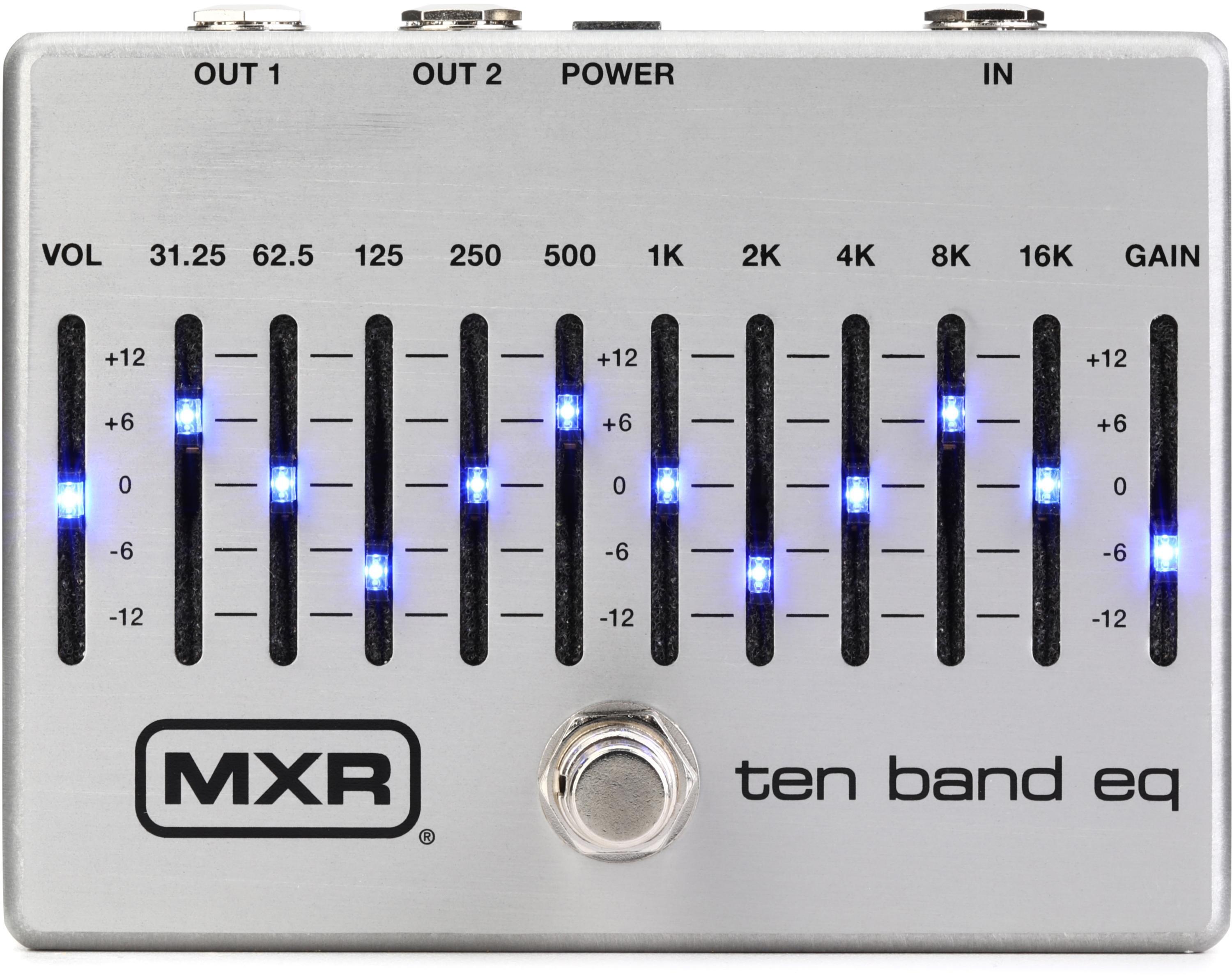
I run an MXR 10-band in the loop of my amps and pull that 16K slider down. This reduces that super high-end fizz many people dislike. Because the neighboring slider is 8K, the curve probably extends up from there. Whatever it's doing, it's working for me :)

684a0e450dUxV770SERV660Eb3vzebkYPzG7YzgB.jpg


Does the amp have separate bias controls for the inner and outer power tubes?
Because EL34 and 6L6 require completely different bias settings.
Yes, it has individual bias.

I'm happy for you that you're so very satisfied with this amp :thumbsup:
Thanks! Yeah it sounds pretty good.

The fact that the amp has "Girth" & "Grind" controls in front of the gain control makes me suspect with almost certainty that Mike has once again adapted my circuit concept from the Dino, as he once did with the Natas and the Randall Satan.
The Sweep control is the extended version of the Body switch of the Dino. I have two switchable resistors, with Sweep exactly this point is adjustable via pot
Your designs are obviously amazing. The build quality is fantastic. You are a wealth of information and I learned a lot from you back when Metro Forum was still active. It really does suck when someone else copies something you worked hard to create. It's happened to me before too. I don't know if you remember, but you even sent me parts in the past.

The only reason I bought the EP was because I played one recently and it surprised me with how good it sounded. I wasn't planning on ever getting one. I'd love to try one of your amps, but a little pricey for me and you've also announced you're no longer accepting orders...

However, since the delivery of the EP was postponed again and again every few months, I canceled my order 2 years later.
Yeah, I don't think I have that kind of patience. It sucks when you buy something and then have to wait multiple years for delivery.
 

Similar threads

Back
Top