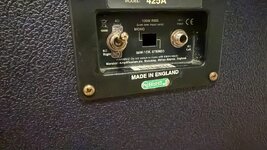
Mesa 4x12 Wiring: Before and After

Not that its the same, but I usually disconnect all that stereo stuff and wire my Mesa cabs for 1 input mono with a pure tone jack. Those weird Switchcraft #13 jacks give me too many issues. I never really noticed anything different, just do it for peace of mind.

However I do rewire all of my 16 Ohm cabs (Bogner, Marshall, Orange, etc..) into 4 Ohms. I use Seymour Duncan Powerstage 170, 16 Ohm just soaks that power and the cab sounds wimpy as fuck turned up. Swapping them to 4 Ohms really pushes the speakers and I feel like I get a fuller sound.
 
rewired cabs over the weekend and tested. 10 gauge has something over the smaller gauges. Open and punchy. But going straight to Jack and wiring in the SP / PS switch made a big difference. Some of my amps sound best series parallel. Some sounded best parallel series. Having the switches on my cabs makes matching them up perfect. Over here, series parallel sounds more articulate and open and perhaps punchier, where parallel series sounds more lower mid/mid rangey and slightly subdued up top, but possibly a touch more volume overall. Blurry mids in a good way comes to mind.
 

Attachments

  • att.n6dvZkyu0iKJ4OqWh0I1I9mM9Pz5mkMYvubNyyfBp4g.jpeg
    att.n6dvZkyu0iKJ4OqWh0I1I9mM9Pz5mkMYvubNyyfBp4g.jpeg
    180.8 KB · Views: 11
Not that its the same, but I usually disconnect all that stereo stuff and wire my Mesa cabs for 1 input mono with a pure tone jack. Those weird Switchcraft #13 jacks give me too many issues. I never really noticed anything different, just do it for peace of mind.

However I do rewire all of my 16 Ohm cabs (Bogner, Marshall, Orange, etc..) into 4 Ohms. I use Seymour Duncan Powerstage 170, 16 Ohm just soaks that power and the cab sounds wimpy as fuck turned up. Swapping them to 4 Ohms really pushes the speakers and I feel like I get a fuller sound.
Bro, I use 16ohms and never would you need to say this at my house lol
 
I've A/B'd the 10 awg Bogner Soundrunner wiring with stock 18 awg wire from a Marshall and found quite noticeable differences.
The 10 awg wire sounds deeper and thicker with less high end zing. Feel is more solid and stiffer but less responsive. Not UNresponsive, just less so than with the thinner wire. More fundamental to the note.
The 18 awg wire has more harmonics, chime and the feel is livelier and comparatively out of control but in a good way.
Neither is inherently better but one may match up better with a certain amp or one's tastes.
 
rewired cabs over the weekend and tested. 10 gauge has something over the smaller gauges. Open and punchy. But going straight to Jack and wiring in the SP / PS switch made a big difference. Some of my amps sound best series parallel. Some sounded best parallel series. Having the switches on my cabs makes matching them up perfect. Over here, series parallel sounds more articulate and open and perhaps punchier, where parallel series sounds more lower mid/mid rangey and slightly subdued up top, but possibly a touch more volume overall. Blurry mids in a good way comes to mind.
So glad to see this! Awesome!
 
What are you using the measure this?
ohms meter.
And what does that tell you?
My goal is to match all 4 speakers in the cab within half an ohm of each other to start with. which in turn means, buying extra speakers, or pulling from the stock I've acquired from all the cabs I've torn down over the years. I actually enjoy that, as some of them are older, they sound different. and that's a good thing to me because I use different mics on each of the 4 speakers. (these are studio only cabs) I make sure all wire length between each speaker is the same length as well, so resistance is as equal as possible. that's not to say it is but, the effort was attempted. I always use the same wire cut from a huge spool I bought years ago, as well as solder and flux so, THAT element is always the same from cab to cab. however, I don't publicly share how I wire my cabs.

That said, I've had literally hundreds of guitarist's play through my various cabs over the years and the consistent feedback is, "wow, that cab it tight" or, " it doesn't sag like my cab does" for the longest time I didn't say anything about the mods I did to my cabs, to the players. I just let them do their thing. but usually, I could see some kind of "wow" on their faces so, this is why I keep putting the time into the cabs I mod for my studio needs.

Also, for my fellow studio nerds out there, my usual signal chains are as follows:

FYI, I only use B cabs.

Top left speaker: Neuman, FET47 - mic splitter - Neve 1081 - neve 1084 - CAPI Heider 312.
Top right speaker: Beyer. M160/R-10 Hot Rod - mic splitter - Neve 1081 - Neve 1084 - Eisen eac312v+CAPI 528 fader.
Bottom left speaker: SM57, - mic splitter - Neve 1081 - Neve 1084 Chandler - TG2.
Bottom right speaker: MD421 - mic splitter - Neve 1081 - Neve 1084 - CAPI Heider 312.

So, this usual set up gives me 12 tracks to pick and compare from with the clients' interests and desires.

 
Wow, 10 awg must be enormous; way too much to me to properly fit most standard guitar jacks / terminals, and I’d be afraid to fry that poor old speaker trying to solder it.

16 is as much I’d go personnaly for internal wiring, and usually stay with the standard 18. Sounds just fine to me.
 
I like eutectic solder. But not for snake oil "tone" reasons. I use it when building amps because it goes from plastic state to fully set up over a single temperature, therefore solidifying quicker. This reduces the chances of a cold joint compared to normal 60/40, which solidifies slowly over a range of temperatures.
 
Last edited:
Not that its the same, but I usually disconnect all that stereo stuff and wire my Mesa cabs for 1 input mono with a pure tone jack. Those weird Switchcraft #13 jacks give me too many issues. I never really noticed anything different, just do it for peace of mind.
I've seen those Pure Tone jacks before. They look good. But the only benefit I can see is maybe they hold the 1/4" plug tighter. The typical Switchcraft jack has been used in millions upon millions of guitars, amps, cabs, rack gear, pedals, and other equipment since 1940... That said, I'd rock those Pure Tone jacks if they were easy to get.
 
I started rewiring my cabs because the way they are done in mass production is lazy and halfass. I don't pretend to know if it makes a cab sound better, because I have never done any tests. But I do know that the way I wire them is a lot more solid

However, it amuses me that so many people are kind of poking fun at guys that have tried other things. We are all a little sick with gear.

And @FourT6and2 I am curious. Why did you choose 14 gauge instead of 18? It is curious to me, because it is a strange thing to use 14, but laugh because someone else chooses a bigger gauge
 
How are you switching the cabs? If you’re stopping to unplug one and physically switch the speaker cable, you may not be hearing the difference. You need switch or a cab switcher.

I have a parallel/ series and series/ parallel switch on my workshop cab. I can absolutely hear a difference. It is not subtle at all.

One side of the switch has more low end. The other is tighter. I forget which is which. I just know I liked parallel/ series better.

I’d like to start offering cabs eventually. If I do, I’ll most likely add this switch. I don’t know of anyone else who does. And it’s useful.
There was someone that had that switch on a cab and posted a/b clips on here a few years ago. The difference was pretty easy to hear in the clips, and it backed up my own experience; however, I never went as scientific as installing a switch.
 
I started rewiring my cabs because the way they are done in mass production is lazy and halfass. I don't pretend to know if it makes a cab sound better, because I have never done any tests. But I do know that the way I wire them is a lot more solid

However, it amuses me that so many people are kind of poking fun at guys that have tried other things. We are all a little sick with gear.

And @FourT6and2 I am curious. Why did you choose 14 gauge instead of 18? It is curious to me, because it is a strange thing to use 14, but laugh because someone else chooses a bigger gauge

First, I'm not laughing at people for using whatever gauge of wire they want. I'm laughing at the claim that someone can hear the difference between two common gauges of wire inside a speaker cab. I don't believe that. I'm skeptical someone can pick out 10 AWG vs 14 AWG inside a speaker cab in a double blind test. I'm happy to do the testing with anybody making that claim.

Second, I chose 14 AWG because that is the most common gauge for zip cord speaker wire sold in bulk by trustworthy companies like Redco. It was either 12 AWG or 14 AWG and I chose the smaller of the two for ease of installation:

https://www.redco.com/8114-14-2-Black-Zip-Style-Jacket-Speaker-Cable.html

Third, I've seen the inside of many cabs and the wiring is just wiring. It's pretty simple stuff, so I don't have much to nitpick regarding "mass production" of speaker cab wiring. That isn't to say the manufacturing quality couldn't be better in some cases and I'm all for wanting more durable gear.
 
Last edited:
There was someone that had that switch on a cab and posted a/b clips on here a few years ago. The difference was pretty easy to hear in the clips, and it backed up my own experience; however, I never went as scientific as installing a switch.

If you can find that, please link it.
 
First, I'm not laughing at people for using whatever gauge of wire they want. I'm laughing at the claim that someone can hear the difference between two common gauges of wire inside a speaker cab. I don't believe that. I'm skeptical someone can pick out 10 AWG vs 14 AWG inside a speaker cab in a double blind test. I'm happy to do the testing with anybody making that claim.

Second, I chose 14 AWG because that is the most common gauge for zip cord speaker wire sold in bulk by trustworthy companies like Redco. It was either 12 AWG or 14 AWG and I chose the smaller of the two for ease of installation:

https://www.redco.com/8114-14-2-Black-Zip-Style-Jacket-Speaker-Cable.html

Third, I've seen the inside of many cabs and the wiring is just wiring. It's pretty simple stuff, so I don't have much to nitpick regarding "mass production" of speaker cab wiring. That isn't to say the manufacturing quality couldn't be better in some cases and I'm all for wanting more durable gear.
The only thing i disagree with is when i pull off the back plate and wire breaks, that isn't awesome. That shit doesnt happen with stranded wire. I think pcb jacks for stereo/mono is fucking retarded. And i have seen the way wire is connected to the connectors loose or kinked...
 
The only thing i disagree with is when i pull off the back plate and wire breaks, that isn't awesome. That shit doesnt happen with stranded wire. I think pcb jacks for stereo/mono is fucking retarded. And i have seen the way wire is connected to the connectors loose or kinked...

Totally. That kind of stuff matters when talking about durability/longevity.
 
Know what else helps is not being a total retard in tan pants thinking you will get better tone by upsizing the wire gauge for your speaker cab. So, anyone pls tell us what size conductor is connected to the speaker output jack inside your amp? There's a clue for you. The only reason to upsize is for losses, and how would you get losses? Heat and distance and the rated conductor connected to the output jack is sufficient as sized...I cannot believe the new blood and snake oil being passed around here on Rigtalk these days. You weak fags are down for cork smoke and tea time.

And to the dude who wants his speakers to match within .5 ohms is fucking is low key trippin...that's how much, not even 1 ohm!!! Anyone here think he makes sense with this bullshit? You are fucking high af bro. Get the fuck outta here. Who wants to answer this, how much current will your cab have to handle@100w 2.5A that is why the conductor doesn't need to be all these wild made up specs by lames in tin foil hats.
 
Last edited:
Did you guys rewire your output transformer wires to be 10 gauge along with the bus wire coming off the ohms selector switch to the speaker jacks? How about the bus wire that connects all that shit together? Then the speaker cord coming out of the speaker jack to the cabinet what gauge is that?

For using a simple fluke multimeter on the ohms setting, that that’s really not all that accurate way to measure this.
 
Know what else helps is not being a total retard in tan pants thinking you will get better tone by upsizing wire gauge for your speaker cab. So, anyone pls tell us what size conductor is connected to the speaker output jack inside your amp? The only reason to upsize is for losses, and how would you get losses? Heat and distance and the rated conductor connected to the output jack is sufficient as sized...I cannot believe the new blood and snake oil being passed around here on Rigtalk these days. You weak fags are down for cork smoke and tea time. Fucking old ladies bridge club.

And to the dude who wants his speakers to match within .5 ohms is fucking is low key tripping...that's how much, not even 1 ohm!!! Anyone here think he makes sense with this bullshit? You are fucking high af bro. Get the fuck outta here. Who wants to answer this, how much current will your cab have to handle@100w 2.5A that is why the conductor doesn't need to be all these wild made up spec by lames in tin foil hats.
There is a lot of passion here. I have thought about why it shouldn't matter a lot. But I am also open minded to people that test it. I don't know that measuring is really the way to go, but i think if someone does two cabs side by side and have different shit going and one sounds better, that is good enough for me.

I remember the scumback guy i think was explaining why 12 gauge was better. There was a lot of outrage, and I really didn't understand why.

But after this thread, i know that 12 gauge or greater is fighting words.

I bought a roll of 12 gauge wire to try it out. I really wish i would have made before and after clips. Then i could have put them random and see if anyone could tell. For me, the cab sounded great before, and great after. It is hard to tell if I got more lowend coming through.

But if anyone wants to try, i can send them the wire. It is good tin foil hat type shit
 
Back
Top